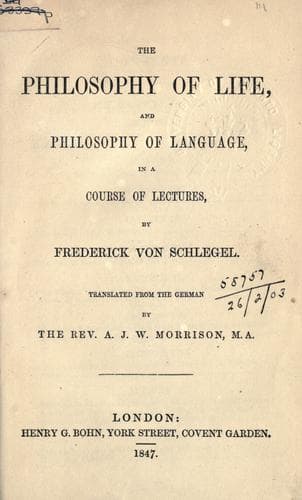
The philosophy of life, and philosophy of language, in a course of lecturesSchlegel, Friedrich von
Philosophy
The philosophy of life, and philosophy of language, in a course of lectures
Schlegel, Friedrich von
Language and languages -- Philosophy; Life; Philosophy
We should err greatly were we to suppose that the cause of truth, and of
the refutation of error, could as easily be disposed of as any civil
process before a judicial tribunal. Here, to carry the day, it is enough
completely to refute the pretensions of one’s adversary, and to set
forth one’s own claim in a clear and irrefragable chain of legal proof.
But, in the matter of philosophy and the higher truth, how little is
gained by the refutation, be it ever so complete, of one written system
of error, when, in the mean while, two or three more spring up and call
for refutation no less than the first. The straight road, therefore, of
a calm, simple, and, at the same time, luminous and complete exposition
of the highest system of knowledge seems, to my mind, a far more
appropriate means for the establishment and diffusion of the truth than
the indirect course of refuting any false or erroneous system that may
reign in a particular age and throughout the whole world. For, in the
latter course, if the controversy be at all searching and complete, it
is necessary to enter into all its tortuous windings, at the risk of
being lost and entangled in them. And even in the most favorable case,
where the refutation is complete, nothing is ultimately gained by it but
a mere negative--the establishing the untruth of the refuted system,
together with the proofs of that negative.
It would be most erroneous to suppose that this controversy is either
entirely or in the main directed against books and leaves, propositions
and words. It looks rather to the soul and spirit, and seeks to drive
away, to remove, and banish from them, and utterly to extirpate, all the
deadly seeds of error and falsehood, replacing them by truth in all its
fullness and energy, so as to win the minds and souls of men to its
beneficent rule.
This, however, is only possible by an individual process and a personal
interchange of ideas. For error and the restoration of truth assume a
thousand different shapes, according to the different temperaments of
individuals, or to the different periods of life in each. If, therefore,
it be the wish or duty of philosophy to make this its principal aim, it
is only in the form of dialogue that it can successfully accomplish the
task, by suiting itself and closely conforming to the personal character
of individuals. In this sense, and on this account, Plato, and the other
disciples of Socrates, in their controversy with the Sophists,
invariably employed the dialogical style, and chose this form for the
exposition of their philosophical views. But even the written dialogue
can not do more than exhibit, as it were, a vertical section of the
whole infinite variety of individual views, convictions, and characters.
And what thereupon is to be done in order to set them free and
emancipate them from error, and to win them for, and to fill them with,
the truth?
Public-domain text, read in full here on John Shaqi.
Reviews
Reviews
No reviews yet
Be the first to share your thoughts on this work.
Elsewhere in the archive
Join the Discussion
Join the discussion
Sign in to leave a comment or review.
Sign InorCreate an account