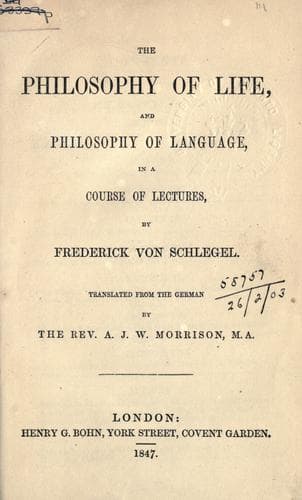
The philosophy of life, and philosophy of language, in a course of lecturesSchlegel, Friedrich von
Philosophy
The philosophy of life, and philosophy of language, in a course of lectures
Schlegel, Friedrich von
Language and languages -- Philosophy; Life; Philosophy
But now, in the very center of man’s history--in the transition-point
between the ancient and the modern world--science and life were again at
unison, as at the beginning. And this was effected by the appearance of
a new science in another form. For most assuredly we shall not err in
giving this name to a new living and spiritual power, which, totally
changing and giving an entirely new direction to the arbitrary views,
sentiments, and principles of public and private life, and also to the
modes of thinking prevalent in the age and in the world, was strong
enough to triumph, not only over heathenism itself, but also over the
science and philosophy of its most enlightened nations. Now this new
mode of thinking, which came forward in the full certainty of the most
undoubting faith and the highest internal illumination, had, so far as
it is right and allowable to call it a science, a very different form
and scope from all that has previously and usually been so called. For
it issued out of the very depths of life, and received from love--a
divine love, that is--its first diffusion and establishment.
Consequently, it was a thoroughly living science, or, as being perfectly
clear and certain in itself, a new scientific life, which, moreover,
proceeded from this its first starting-point, was able to penetrate into
all the other forms of public life and of the anterior systems of
science, and by adopting or remodeling them, give to itself therein a
further and more universal development.
But here, also, the divine impulse from above encountered the usual
partial or entire resistance from below. Accordingly, this new living
wisdom, which, in its essence, is one with life, and which, therefore,
the more it is developed only unfolds this unity the more universally
and the more immutably, was not, at the first, universally adopted, or
did not become every where predominant. Moreover, even where it was
received, and its authority acknowledged, its reception was often little
more than external. It was not admitted as a living principle into all
the depths of the soul, or impressed on all the habits and tendencies
of the mind [_geist_]. And even where, in some degree at least, it was
adopted in the inner man with full and sincere love, it was often
nothing more than an undeveloped germ of the future and of a higher
life. Isolated by itself, and standing apart, it remained shut up within
the inmost bosom, without at the same time penetrating, reanimating, and
giving a new life and shape to all the other life-elements of the
consciousness and the productions of human science.
Public-domain text, read in full here on John Shaqi.
Reviews
Reviews
No reviews yet
Be the first to share your thoughts on this work.
Elsewhere in the archive
Join the Discussion
Join the discussion
Sign in to leave a comment or review.
Sign InorCreate an account