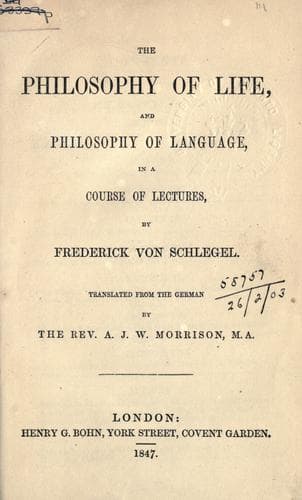
The philosophy of life, and philosophy of language, in a course of lecturesSchlegel, Friedrich von
Philosophy
The philosophy of life, and philosophy of language, in a course of lectures
Schlegel, Friedrich von
Language and languages -- Philosophy; Life; Philosophy
How, now, is this our (_b_) to be carried back to its original (_a_)?
How is it to be set free from this evil (_y_), and brought into union
with the highest (_x_)? The answer and solution to this apparently
insoluble equation can only be obtained by one method. In attempting it,
we must keep steadily in view the principle so recently advanced, that
the essence of religion consists in the effectual communication of a
higher and living power, which, emanating from the first and original
point, traverses the whole spiritual chain to its farthest link. But, in
order to illustrate completely this principle, and the idea which arises
from it, of a satisfactory solution of this problem, I will indulge
myself in a brief but episodical explanation of the Egyptian
hieroglyphics, as furnishing the most suitable example for my purpose.
For, inasmuch as the symbolical nature and constitution of the human,
and, indeed, of all mortal existence, was the main subject which opened,
and has occupied our present consideration, it may be regarded as the
natural complement and keystone to the whole discussion, if, in addition
to what has preceded, we go on briefly to examine how and in what sense
the oldest writing and earliest method employed by men for the
communication of their ideas was symbolical.
Of the languages of Western Asia, at least, and of the alphabets derived
therefrom, the Hebrew, viz., the Phœnician and the Greek, it may
without hesitation be asserted, that they were derived from
hieroglyphics, and are, without exception, of hieroglyphic origin. This
can not be asserted as decidedly of the Indian alphabet, which differs
so totally from all those previously mentioned. Still I shall not allow
myself, simply on this account, to come over hastily to any conclusion
as to the comparative antiquity of the Hindoo and the Egyptian modes of
writing.
Now, according to all that we know of the hieroglyphical mode of
indicating objects, it rests on a very simple principle. The discovery
which was in so remarkable a manner reserved to our own age, is not
indeed complete, and leaves much still to be explained. The fundamental
principle, nevertheless, is well established. From this it appears that
the hieroglyphic system of Egypt, although entirely symbolical,
contains, notwithstanding, the germ of alphabetical writing. As the
principle of hieroglyphical writing is equally applicable to modern
languages as to the Egyptian, a German word will serve us as well for an
example, and for the purposes of our illustration, as any other.
Preliminary, however, it is necessary to observe, that in this mode of
notation the leading characters and essential elements of the radical
sound are alone indicated; such vowels and consonants as are quiescent,
or servile, are omitted, and being without any special signs are left to
be mentally supplied.
Public-domain text, read in full here on John Shaqi.
Reviews
Reviews
No reviews yet
Be the first to share your thoughts on this work.
Elsewhere in the archive
Join the Discussion
Join the discussion
Sign in to leave a comment or review.
Sign InorCreate an account