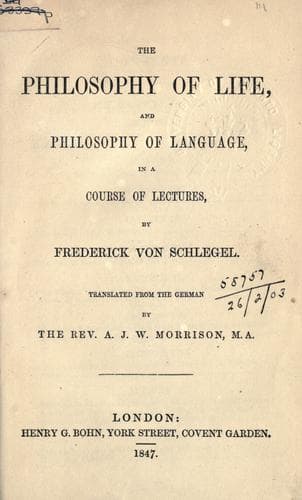
The philosophy of life, and philosophy of language, in a course of lecturesSchlegel, Friedrich von
Philosophy
The philosophy of life, and philosophy of language, in a course of lectures
Schlegel, Friedrich von
Language and languages -- Philosophy; Life; Philosophy
By the ascription to the imperial dignity of priestly offices and titles
belonging to the popular religion, it was indeed attempted to give it a
more sacred character and sanction. This, however, secured to the
emperor no real accession of power. Such was the state of decay and
weakness in which religion, no less than morals, was sunk. The
heathenism of those days consisted in nothing but some poetical legends,
external rites, and ceremonial pomp, which occasionally found a
philosophical interpretation, but without a proper intrinsic substance
and coherence, and an organized priesthood--all which are to be still
found in the ancient religion of the Hindoos. And it was only a natural
addition to the other numerous inconsistencies--it only rendered the
whole drama the more revolting, if, after an inhuman reign, and after
being at last put out of the way in a very human, and, at the same time,
very _un_human way, the hated tyrant was in conclusion placed among the
national gods. And if under Aurelius and the Antonines better days
appeared, still they were but brief and transitory, since they did not,
and in truth could not, possess any historical confirmation and moral
basis like that of the hereditary monarchy of Christian times and
states.
In jurisprudence, not only as a science, but in its practical
administration, the Romans have in all ages, and even modern times, been
justly famous. One reason, perhaps, of this was the fact, that all who
still retained the least sense of right and justice, withdrawing from
the dangers of political life and honors, retired to the still inviolate
domain of law, and devoted themselves to the development of the old
juristic principles. But when the whole social frame, and the very
principle of civil existence has become in its inmost essence
unrighteous, and based on injustice, a few just laws about property, and
robbery, and fraud, and murder, and the like (offenses which, generally
speaking, are, for the most part, essentially the same in all times and
places), can profit little. Equally unavailing, too, are the shrewdest
and most sagacious of juridical treatises on such topics. To extol the
Roman Empire on this ground would be tantamount to praising one of the
worst and most pernicious systems of philosophical error, or excusing it
because it does not violate, or, rather, because it necessarily
observes, the ordinary rules of logic, which, however, does not by any
means lessen or remove the error, but, on the contrary, aggravates it;
since by rendering it so much the more specious, it does but gain for it
a more ready acceptance among men.
Public-domain text, read in full here on John Shaqi.
Reviews
Reviews
No reviews yet
Be the first to share your thoughts on this work.
Elsewhere in the archive
Join the Discussion
Join the discussion
Sign in to leave a comment or review.
Sign InorCreate an account