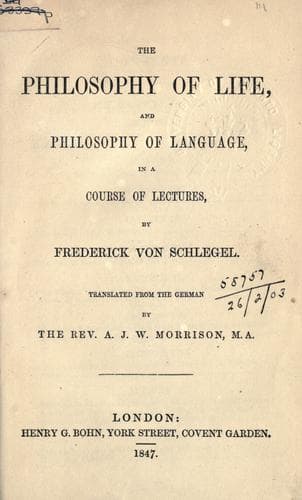
The philosophy of life, and philosophy of language, in a course of lecturesSchlegel, Friedrich von
Philosophy
The philosophy of life, and philosophy of language, in a course of lectures
Schlegel, Friedrich von
Language and languages -- Philosophy; Life; Philosophy
This peace-loving and tolerant recognition of imperfect political
constitutions and forms of state is only applicable, however, where the
absolute and the pernicious had its foundation in some historical
occasion, and where, by a natural course of development, the evil has
followed as the result of some previous defective condition of the
political body. It has no place where the evil is radical and of
spontaneous growth, as in the empire of Mohammed, and of his immediate
successors; for a fanatical lust of conquest was introduced in the first
germ of this dynasty, and indeed formed its foundation and its animating
and vital principle. The brilliant success and personal talents of the
first caliphs may indeed win our admiration and chain our imagination,
but still in the very worst times of the old Roman world absolute power
never presented itself in so unmitigated a form as it does in this
empire of deadly fanaticism. This is the calm judgment of history. In
the former case the evil sprung chiefly from the personal caprice of
individual tyrants; in the latter, the pervading principle was
despotism, which, on the whole, remained unchanged in the most famous
and greatest characters. For such immutability is an essential principle
of despotism whenever the spiritual and the temporal power are held by
the same hand, and are united in one common center and sovereign.
In another point of view also, that, viz., of the moral estimate, the
historical comparison between the old Roman and the Mohammedan empires
turns out to the disadvantage of the latter. In the latter times of the
Roman Empire, the family relations, and the sacred ties of married life,
were no doubt greatly disturbed and perverted by the prevailing tone of
immorality. But among the Mohammedans they were entirely overthrown by a
false religion. Even in this respect, therefore, it is evident that
there could be no place in the latter for that moral foundation of a
long-established family unity, such as a civilized state like the
Christian monarchy requires. It is nothing strange, consequently, if in
the times of the Arabian dynasty, the Mohammedan state stood in more
decided opposition, and proved less reconcilable to the Christian polity
than ever heathenism did in the days of ancient Rome. But,
notwithstanding this, we find, on the other side, the Christian
principle of peace extending itself even to the historical phenomena and
political relations of the Mohammedan world. For the most part (and in a
greater degree with the advance of time) these events have been judged
in that mild spirit of historical justice which, in its complete and
comprehensive estimate, allows a due consideration to every motive and
circumstance.
Public-domain text, read in full here on John Shaqi.
Reviews
Reviews
No reviews yet
Be the first to share your thoughts on this work.
Elsewhere in the archive
Join the Discussion
Join the discussion
Sign in to leave a comment or review.
Sign InorCreate an account