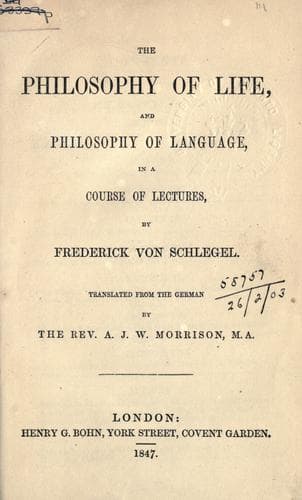
The philosophy of life, and philosophy of language, in a course of lecturesSchlegel, Friedrich von
Philosophy
The philosophy of life, and philosophy of language, in a course of lectures
Schlegel, Friedrich von
Language and languages -- Philosophy; Life; Philosophy
Among the Greeks, for example, rhetoric became the mere slave of an
extremely corrupt government, and followed it in all its disorders.
Poetry, indeed, was the handmaid of the heathen worship and its
religious legends; but still, as being an art and the sport of fantasy,
it moved with a considerable degree of freedom. Accordingly, in the best
and purest and greatest of the poets of antiquity, a profound and
significant symbolism of life lies under, and occasionally appears on,
the surface of their works, which, as considered from a right point of
view and in a liberal spirit, is neither totally repugnant nor directly
opposed to a higher, or even the highest, _i.e._, Christian truth. But
still such notes of a divinely-inspired feeling, which in the
inspiration attains to a clearer perception of the divine nature, is
very far from amounting to the power of an idea, and its actually and
determining influence on life. The philosophy and science of the Greeks,
from its beginning to its close, stood in decided opposition both to the
popular religion and to the state. Accordingly, they either exercised no
influence at all on life, or, at least, no uncontested one. At any rate,
their effects were very trivial. All that can be justly said of the
subject of Grecian science or the ideas of the Greeks applies, with a
slight modification and in a less general sense, to those of the Romans.
The remarks we made above on ancient art and poetry hold good, though in
a somewhat different application, of the romantic portion of the middle
ages, its legends, namely, and poetic fictions. However important the
nobler aim which fancy here pursued to influence morals and life, still
the idea of the power of science can scarcely come in here. As for
science itself, the medieval mind was divided in its pursuit of it. On
one hand there prevailed a strong desire after what was forbidden--or at
least was supposed to be forbidden--the old heathen philosophy; on the
other, as soon as it appeared impossible to get rid of it altogether, an
anxious endeavor to come to an equitable compromise with it, or at least
to make a rationally Christian application of it, and especially of
Aristotle, who, in the judgment of those days, ruled as supreme monarch
over all the sciences. Under these circumstances, and confined by these
chains of authority, it was impossible for Christian science to put
forth its full power and might, or to exercise any material influence on
the age or on life. On the contrary, agreeably with the very principle
of the Christian life, the latter shows itself only in writers like St.
Bernard, who did not belong to the schoolmen. For in the genuine
scholastic philosophy, as having its origin in a perfectly heathen
dialectic, neither the method nor the forms of thought could be purely
Christian.
Public-domain text, read in full here on John Shaqi.
Reviews
Reviews
No reviews yet
Be the first to share your thoughts on this work.
Elsewhere in the archive
Join the Discussion
Join the discussion
Sign in to leave a comment or review.
Sign InorCreate an account