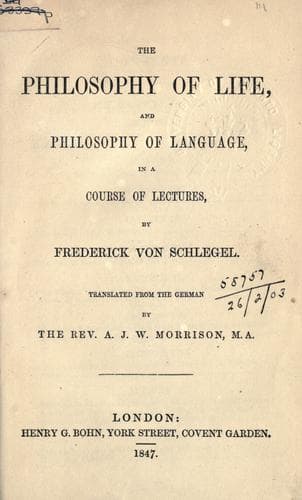
The philosophy of life, and philosophy of language, in a course of lecturesSchlegel, Friedrich von
Philosophy
The philosophy of life, and philosophy of language, in a course of lectures
Schlegel, Friedrich von
Language and languages -- Philosophy; Life; Philosophy
this, that they abandon the standard of humanity, by seeking to wrest,
and to conquer an unhuman, if we may so say, _i.e._, a wholly
independent and absolute knowledge, which, however, it is not in their
power to attain to, and in pursuit of which they lose the certainty
which lies within their reach, and so at last grasp nothing but an
absolute not-knowing, or an endless controversy. If, as we can not but
suppose, a communication does take place among those spiritual beings,
who in intelligence are preferred to man, then must the immediate speech
of these spirits be very different from our half-sensuous half-rational,
half-earthly half-heavenly language of nature and humanity. For, even as
spiritual, it can not but be immediate--never employing figure and those
grammatical forms which human language first analyzes, to form again out
of them new and fresh compounds. According to the two properties which
constitute the essence of mind [_geist_], it can only be a
communication, a transmission, an awakening or immission of
thought--some wholly definite thought--by the will, or else the
communicating, exciting, and producing by the thought of some equally
definite volition. It may be that something of this, or at least
something not absolutely dissimilar, occurs in human operations. It is
possible that this immediate language of mind, as a secret and invisible
principle of life--as a rare and superior element--is contained also in
human language, and, as it were, veiled in the outer body, which,
however, becomes visible only in the effects of a luminous and lofty
eloquence, in which is displayed the magic force of language and of a
ruling and commanding thought. Taken on the whole, however, human
speech is no such immediate and magically-working language of mind or
spirit. It is rather a figurative language of nature, in which its great
permanent hieroglyphics are mirrored again in miniature, and in rapid
succession. And it retains this natural and figurative character even in
the ordinary form of rational dialogue, which must observe so many
varieties and details of grammar, of which superior intelligences have
no need for their immediate intercommunion, but in which, as in all
other human things, many greater or less grammatical oversights creep in
and give rise to important consequences in science and thought, and also
in life itself. But in the next place, language is intimately connected
and co-ordinate with tradition, whether sacred or profane, with all the
recorded fruits of human speculation and inquiry. And as the word is the
root out of which the whole stem of man’s transmitted knowledge, or
tradition, has grown up, with all its branches and offshoots, so, too,
in the eloquent speech, in the elegant composition, and even in all
lofty internal meditation--which form, as it were, the leaves, flowers,
and fruits of this goodly tree of living tradition--it is again the word
by which the whole is carried on and ultimately perfected.
Public-domain text, read in full here on John Shaqi.
Reviews
Reviews
No reviews yet
Be the first to share your thoughts on this work.
Join the Discussion
Join the discussion
Sign in to leave a comment or review.
Sign InorCreate an account