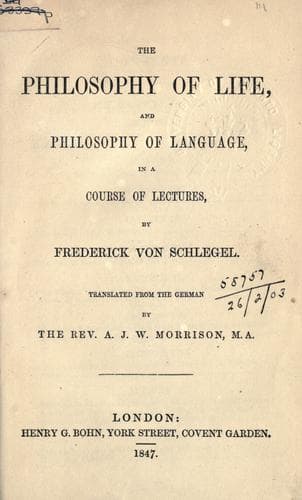
The philosophy of life, and philosophy of language, in a course of lecturesSchlegel, Friedrich von
Philosophy
The philosophy of life, and philosophy of language, in a course of lectures
Schlegel, Friedrich von
Language and languages -- Philosophy; Life; Philosophy
But now, in order to develop still more completely, and more accurately
to ascertain the part which the soul, as the creator of language,
contributes to human cognition and knowledge, it will be necessary to
examine nicely the essence of reason, and especially in relation to its
collateral and closely-connected, but subordinate faculties. Above all,
it will be advisable to determine, as accurately and carefully as
possible, the difference between reason and understanding. For otherwise
its proper share in this common fruit and joint product of human
knowledge can not be ascribed to each power of mind and to each faculty
of the soul, nor their proper places and due limits in the whole be
severally assigned.
The faculties, then, of the soul, which stand in the same close
relationship to the reason that the senses and the instincts or passions
do to the fancy, are memory and conscience. Now, memory may be
considered either as a gift, according to its greater or less power of
comprehension and retention, or as an art to strengthen and facilitate
its operations by artificial means of every kind, or as a problem to
determine how far the exercise of it constitutes an essential part of
man’s intellectual culture and development. But it is not in any of
these points of view that we have here to consider it, but simply in its
essential conjunction with the reason and rationality, which appear to
be dependent on this union.
In other words, we have to regard the memory principally as the inward
clew of recollection and of association in the consciousness, in the
ever-flowing stream of thought and interchange of ideas. We may, or, I
might rather say, we must, forget infinitely many things. But this
connecting thread of memory being once broken, or destroyed, or lost,
the reason invariably suffers with it, and is injured, or its exercise
limited, or, lastly, is rendered totally confused and extinct. Whenever,
in the extreme decrepitude of old age, memory fails, reason ceases in an
equal degree to be active and energetic, and is supplanted by more or
less of a foolish doting. In sleep, no doubt, consciousness is regularly
interrupted, but still it is immediately restored again on awaking. If
the contrary were to take place, if, as is the foundation of many an
ingenious story among the poets, when suddenly awakened we could not
recall our former memory and our knowledge, then should we be
continually falling into mistakes about ourselves and lose all identity
of consciousness. Some such violent interruption or rent in the inward
memory of self-consciousness is invariably to be found in madness, and
is a leading symptom of it. And here I would merely call upon you to
observe a further illustration of what has been already more than once
pointed out. The triple principle of body, soul, and spirit is again
repeated and manifested even in this sad state of mental alienation, and
in all its different forms and species. In true lunacy or
Public-domain text, read in full here on John Shaqi.
Reviews
Reviews
No reviews yet
Be the first to share your thoughts on this work.
Join the Discussion
Join the discussion
Sign in to leave a comment or review.
Sign InorCreate an account