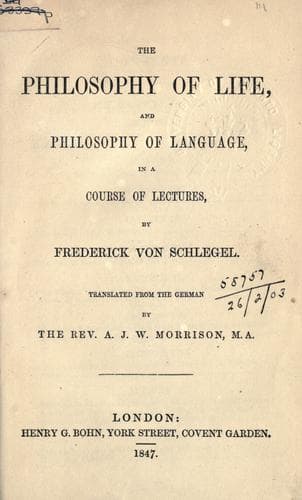
The philosophy of life, and philosophy of language, in a course of lecturesSchlegel, Friedrich von
Philosophy
The philosophy of life, and philosophy of language, in a course of lectures
Schlegel, Friedrich von
Language and languages -- Philosophy; Life; Philosophy
Now, the outer and especially the higher senses may, by reason of the
supremacy of the fancy, to which they are subordinate, be termed, with
propriety, so many applied faculties of imagination. In the same way we
might give the same designation to the inclinations and impulses--the
good as well as the evil--if, perhaps, it would not be more accurate to
name them an imagination passed into life. In a similar way the memory
may be considered as an applied reason which in the application has
become quite mechanical and habitual; for unquestionably the logical
arrangement is the chief quality in memory. From this it derives both
its value and scientific utility. On the other hand, there are certain
acquired mental aptitudes which, though originally they can not be
formed without the voluntary exercise of memory, become at last a
completely unconscious and mechanical operation--the facility, for
instance, of learning by heart, or the acquisition of foreign languages,
or catching up of musical tunes. In all these the reason has become an
instinct, just as the instinct of animals, their artistic impulse and
skill, may be designated an unconscious analogy of reason.
In this subordinate faculty of the memory, the reason, agreeably to its
specific character, exhibits itself as a useful and ministering agent.
In conscience, on the contrary, as its highest function, it assumes a
somewhat negative character. But in both relations, whether as a
ministerial or negative faculty of thought, the reason, in its place, is
of the highest value. If occasionally we have seemed to detract from and
to limit its importance, such remarks have been called forth by the
undue and overweening authority which the present age would claim for
the reason. This is the sole end and meaning of our opposition, which is
directed exclusively against that spurious reason which claims to be
supreme, and arrogates to itself a productive power; whereas, in truth,
it ought not to be the one, and can never be the other. The thought
which distinguishes, divides, and analyzes, and that also which
combines, infers, and concludes--which, as such, make up the faculty of
reason--may be so carried on in indefinite and infinite process, as
ultimately to get entirely rid of its object-matter. It is this endless
thinking, without a correspondent object, that is the source of
scientific error, which, as in all cases it arises solely out of this
vacuum in thinking, can only lead to a thinking of nothing--a cogitation
absolutely null and false. Far different is the case where a memory,
stored with the rich materials of intellectual experience, forms the
useful basis of man’s studies and pursuits, or where, as is the case
with the apperception of the conscience, the object, even while it is
less extensive and manifold, is the more highly and more intensely
important. Now, as the reason generally is not only a combining and
connecting, but also a distinguishing faculty of thought, so likewise
Public-domain text, read in full here on John Shaqi.
Reviews
Reviews
No reviews yet
Be the first to share your thoughts on this work.
Join the Discussion
Join the discussion
Sign in to leave a comment or review.
Sign InorCreate an account