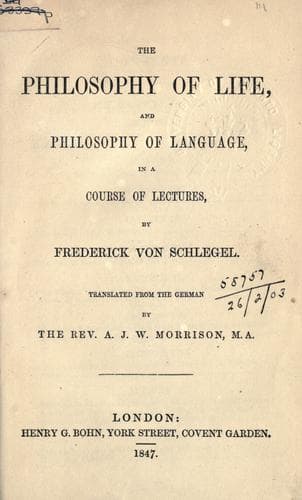
The philosophy of life, and philosophy of language, in a course of lecturesSchlegel, Friedrich von
Philosophy
The philosophy of life, and philosophy of language, in a course of lectures
Schlegel, Friedrich von
Language and languages -- Philosophy; Life; Philosophy
the conscience is a similar power of drawing distinctions in the thought
and in the internal consciousness, though in a higher and special
degree, and also in a different form from that which, in all other
instances, is discursive reason. For it is by a simple feeling and
immediate perception that the conscience, in obedience to the voice
within man, draws between right and wrong, or good and evil, the
greatest of all distinctions. This voice of conscience, while it makes
itself heard among all nations, nevertheless, under the ever and
widely-varying influence of ruling ideas of the age, and of education,
and of custom, speaks in different times and places, in differing tones
and dialects. But these differences extend only to subordinate matters.
The primary and essential point remains unchanged and never to be
mistaken; the same dominant tone and key-note sounds through all these
variations--the common tongue and language of human nature and of an
untaught and innate fear of God. This fact has led many to regard the
conscience as the principal source of all higher and divine truth; with
whom I can readily concur, so long as they do not mean thereby that it
is the only source, to the exclusion of every other.
Now it is surely significant that in German--and all languages furnish
numerous instances of such significant allusions--the word and the name
of reason[17] is derived from that internal perception of the conscience
which constitutes its highest function. What, then, it may be asked, is
perceived by this wonderful perception, that before it the will inwardly
retires and withdraws even its earlier and most cherished wishes? The
warning voice it is called, in every age and nation. It is, as it were,
one who within us warns and remonstrates. It is not, therefore, our own
Me, but as it were another, and, as a vague feeling would suggest, of a
higher and a different nature. And now by its light that earlier and
retiring will appears in like manner as another self--a lower false and
seducing Ego--an alien power which would hurry away ourselves and our
proper Me. But between the two--this higher warning voice on the one
hand, and this constraining, compelling force on the other--there stands
a power which is free to decide between them. And this, as soon as the
decomposing process is finished, which in the as yet undecided will, or
its mixed states, separates and distinguishes between the good voice and
the evil inclination--remains to us as our own Ego and our proper self.
This inward voice, and the immediate perception of it, is an anchor on
which the vessel of man’s existence rides safely on the stormy sea of
life, and the ebb and the flow of the will. In other words, it is a
divine focus, or a sacred stay of truth. But further, it must be
observed, that the understanding of this inner perception, as I have
just painted it, does not belong to the reason, to which alone the
perceiving can itself be ascribed. The true intelligence thereof--its
Public-domain text, read in full here on John Shaqi.
Reviews
Reviews
No reviews yet
Be the first to share your thoughts on this work.
Join the Discussion
Join the discussion
Sign in to leave a comment or review.
Sign InorCreate an account