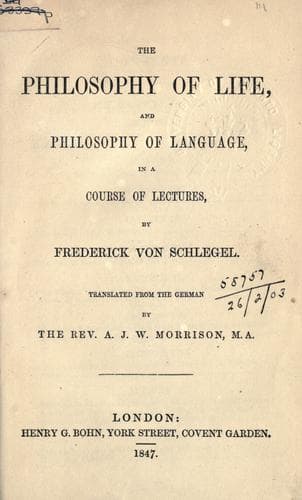
The philosophy of life, and philosophy of language, in a course of lecturesSchlegel, Friedrich von
Philosophy
The philosophy of life, and philosophy of language, in a course of lectures
Schlegel, Friedrich von
Language and languages -- Philosophy; Life; Philosophy
But now, in Holy Writ, and in the language of pious adoration and
prayer, among other nations as well as the Jewish, a multitude of
properties, faculties, and senses are ascribed to the Deity in perfectly
anthropomorphic descriptions and imagery. Thus mention is even made of
His eye, His ear, His guiding hand, His mighty arm, and the omnipotent
breath of His mouth. In so far as these are admitted to be mere images
there can be no objection to them, and it is not easy to see how they
can lead to any abuse. And this is equally the case even with such
expressions as it is plain can only be applicable to the Deity in a
figurative sense--for instance, when human passions are ascribed to
Him--since, if employed properly and literally, they all involve more or
less of imperfection. And in the same way, where no forgetfulness is
possible or conceivable, it can only be in a figurative sense that it is
allowable to speak of memory. And with still less propriety can the
faculty of conscience, in its human sense, be ascribed to God. His
balance of justice--His regulative thought--is something very different
from our mere sense of right. To ascribe conscience to the Deity would
be to confound the judge on the bench with the criminal at the bar. Even
the first man, as long as he was yet innocent, knew not conscience. For
the sense of guilt, and the faculty of perceiving it, must at the very
earliest have come simultaneously with the transgression itself, if it
was not, rather, consequent upon it. In the application to the Deity of
such figurative language, great license is of course allowable. The
question, however, which concerns us in a philosophical point of view is
whether, in the same proper sense as understanding and will, so also the
other faculties which are so peculiarly distinctive of man--reason and
fancy, or the soul--can be attributed to the Divine Being. Now it is at
once evident that, far beyond all other figurative expressions, it would
be perfectly unsuitable to ascribe fancy to God. We feel clearly enough
that by so doing we should be leaving the safe ground of truth for the
treacherous domain of mythology. That inner mine of intellectual riches
which man in his weak measure finds in the faculty of fancy, is, in the
case of the Divine Being, furnished once and for all by His omnipotent
will; which of itself creates and produces its object, and, unlike
created beings, is not confined to any limited data or to a choice
between them. Here, then, the Almighty will itself is the full fatherly
heart--embracing, nourishing, and sustaining all creatures--or even the
living maternal womb of eternal generation, and requires no new and
special faculty for this end. In the next place, as to the soul: the
expression of the soul of God does, indeed, occur in some of the less
known Christian writers of the first centuries of the church, but it
soon fell into disuse--from a fear, probably, of its leading to a
Public-domain text, read in full here on John Shaqi.
Reviews
Reviews
No reviews yet
Be the first to share your thoughts on this work.
Elsewhere in the archive
Join the Discussion
Join the discussion
Sign in to leave a comment or review.
Sign InorCreate an account