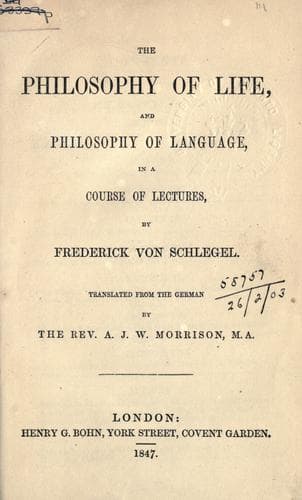
The philosophy of life, and philosophy of language, in a course of lecturesSchlegel, Friedrich von
Philosophy
The philosophy of life, and philosophy of language, in a course of lectures
Schlegel, Friedrich von
Language and languages -- Philosophy; Life; Philosophy
higher interpretation, and explanation, which adds to it, or recognizes
in it a reference to the divine--must, even because it is an
intellectual act, be ascribed to the understanding.
The present, therefore, is the place for a close and accurate
investigation of the difference between reason and understanding--a
question of the highest importance for the whole theory of the
consciousness, and its true philosophical interpretation, as well as
absolutely for every branch of science. For this purpose I shall follow
a line of thought somewhat unusual, perhaps, but which on that account
is even the more likely to carry us quickly to the desired end, and to
place the distinction in a full and clear light. I lately employed the
somewhat hypothetical comparison between man and a superior order of
intelligences, as a means of illustrating the faculty of the fancy as
the peculiar property of the human consciousness. And now I would go a
step higher, and from the acknowledged characteristics of the divine
intelligence, derive the means of determining the different functions of
the human consciousness, and of setting the relations they stand in, not
only to one another, but also to a superior intellect. In this course,
however, I shall take nothing for granted but what is well known and
generally intelligible. That God is a Spirit, is the concurrent voice of
all men, wherever a belief in the one God is professed, or the idea of a
Divine Being is diffused. God is a Spirit, and therefore an omniscient
intellect and an all-mighty will are unanimously attributed to Him. This
axiom, with which a child even of the most ordinary intelligence can
associate some kind of meaning, is at the same time the fundamental
principle which is involved in all that the deepest thinker can know of
God. The same faculties, therefore, that make up the essence and the two
functions of created spirits--understanding and will--may, without
hesitation, be attributed to the uncreated Spirit; and although this
attribution must be understood according to the exalted standard of the
infinite distance between the creature and the Creator, still it is made
properly and not merely by way of figure.
Public-domain text, read in full here on John Shaqi.
Reviews
Reviews
No reviews yet
Be the first to share your thoughts on this work.
Join the Discussion
Join the discussion
Sign in to leave a comment or review.
Sign InorCreate an account