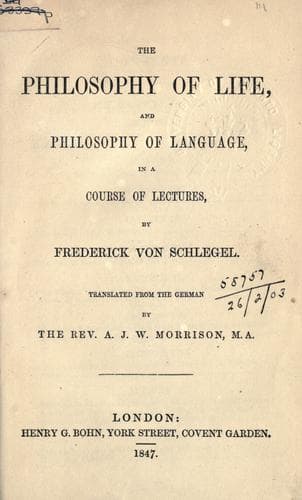
The philosophy of life, and philosophy of language, in a course of lecturesSchlegel, Friedrich von
Philosophy
The philosophy of life, and philosophy of language, in a course of lectures
Schlegel, Friedrich von
Language and languages -- Philosophy; Life; Philosophy
Such is the course of things, or, rather, the higher Providence that
rules therein; and it was to this, chiefly, that I wished to call your
attention by this digression. Thus slow and gradual, but permanent, are
the progressive steps in the growth and development of true human
science, which is founded on experience--the internal as well as
external, the higher as well as the lower--and on tradition, language,
and revelation. But, on the contrary, that false, or, as I termed it at
the outset, that unhuman and absolute knowledge, as it pretends to
embrace all at once, and by one step to place us in full possession of
the whole sum of human knowledge, so, ever fluctuating between being and
non-being, it soon dissolves into thin air, and leaves nothing behind
but a baseless void of absolute non-knowing. Ill would it fare with the
knowledge of God and of divine things, if they were left to be
discovered, and, as it were, first established by human reason. Even
though, in such a case, the intellectual edifice were never so well
built and compact, still, as it had originally issued out of man’s
thoughts, it would be ever shaking before the doubt whether it were any
thing better than an idea, or had any reality out of the human mind.
For this doubt is the foundation of all idealism, to which, often
recurring under differing forms of error, it does but give a fresh
creation and new shape. Even from this side, consequently, it is
apparent that no living certainty and complete reality is attainable by
it. Easy, in truth, were it from this position to evolve the ideas of
the illimitable, and the infinite, and the absolute; and of such
developments there is no lack. But they are at best but pure negations,
which do not serve in the least to explain that which is most necessary
for us to understand. Curious, indeed, should I be to see the process by
which, out of this pet metaphysical idea of the absolute, any one
positive notion of God--His patience, for example, and long-suffering--is
to be deduced. Strange, too, must be the way in which alone it could
carry out the proof that the absolute Deity, or as man prefers, it
seems, to say, _the Absolute_, can not dispense with the possession of
this attribute of patience, on which, however, before all others, it is
important for man to insist. Moreover, this character of absoluteness
is applied to the Deity in a manner which is altogether false and
erroneous. That God, in the mode of his existence, is unlimited--that
the First Cause is not dependent on, and can not be qualified by any
other being, is self-evident, and is nothing but a mere identical
proposition. But this character does not admit of being applied to
his inner essence, or His essential attributes in relation to man and
the whole creation. Wo to all men, nay, we might rather say, wo to
all created beings, if God were really absolute--if, for instance,
His justice, which, however, is the first and principal of all His
Public-domain text, read in full here on John Shaqi.
Reviews
Reviews
No reviews yet
Be the first to share your thoughts on this work.
Elsewhere in the archive
Join the Discussion
Join the discussion
Sign in to leave a comment or review.
Sign InorCreate an account