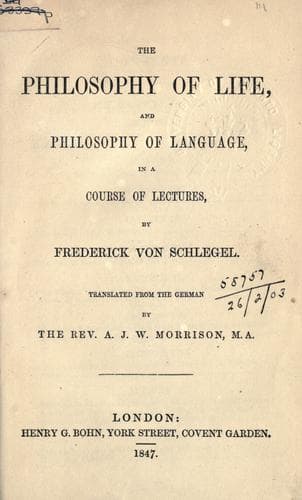
The philosophy of life, and philosophy of language, in a course of lecturesSchlegel, Friedrich von
Philosophy
The philosophy of life, and philosophy of language, in a course of lectures
Schlegel, Friedrich von
Language and languages -- Philosophy; Life; Philosophy
attributes, were not manifoldly modified, limited, and conditioned by
His goodness, His mercy, and His patience. Before such a justice of
God, if it were at once to make such an unconditional manifestation of
itself, the whole world in terror would sink in dust and ashes. But it
is not so. Man does hope--he must believe--ay, we may go on and add,
man does know, that the divine justice is not unconditional, but is in
an eminent degree limited by His fatherly love and goodness.
No doubt, too, it must not, on the other hand, be forgotten, that the
divine love and grace are also conditioned by the attribute of justice,
what, however, in a certain effeminate theology of a recent day, seems
to have been totally overlooked. However, this grave error of a too
sentimental view of divine things is now pretty generally recognized as
such, and, for the most part, abandoned. Moreover, it does not properly
lie within the scope of our present disquisition. Now, the position that
the justice and the grace of God mutually limit each other, involves
nothing unintelligible, or, in this sense, inconceivable; as, however,
is the case with the baseless phantom of the absolute, where the empty
phrase becomes only the more unintelligible the more frequently it is
repeated. How much more correct, in this respect, were the definitions
and distinctions of the great philosophers of antiquity, especially the
Pythagoreans. With them the limitless and the indeterminate were even
the imperfect and the evil, and the former they regarded as the
characteristic marks of the latter; while the fixedly definite and
positive, which forms the very heart and core of personality, was with
them identical with the good: and unquestionably, God’s personality--the
fundamental notion, the proper and universal dogma of every religion
that acknowledges the one true God--is the true center around which the
whole inquiry revolves. For the question is, whether philosophy, while
it allows this idea to stand indeed externally, and apparently--for even
in Germany only one has been found bold enough to deny it expressly and
without reserve--intends all the while to put it quietly aside, and
secretly to entomb it by refusing to see in it any thing more than an
illusion of the natural feelings. The point at issue is whether, by so
teaching, philosophy is to come into direct collision with one of man’s
most universal and deeply-rooted feelings, and to produce an eternal
schism--an irreconcilable discord--not only between science and faith,
but even between science and life. For to unsettle life, is even the
necessary result of rationalism.
Public-domain text, read in full here on John Shaqi.
Reviews
Reviews
No reviews yet
Be the first to share your thoughts on this work.
Elsewhere in the archive
Join the Discussion
Join the discussion
Sign in to leave a comment or review.
Sign InorCreate an account