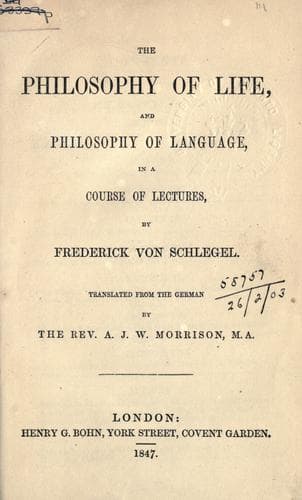
The philosophy of life, and philosophy of language, in a course of lecturesSchlegel, Friedrich von
Philosophy
The philosophy of life, and philosophy of language, in a course of lectures
Schlegel, Friedrich von
Language and languages -- Philosophy; Life; Philosophy
Now, to this first hypothesis we might append the further
question:--supposing that God has imparted a knowledge of Himself to
mankind--has spoken to them, and revealed Himself to them--is it not
highly probable that He has ordained some institution for the further
propagation and diffusion of revealed truth, and also for the
maintenance as well of its original integrity as also of the right
interpretation of it? But I must content myself with merely advancing
this question. I can not attempt to prosecute it in the present place;
for its further consideration would carry us out of the established
limits of philosophy into the domain of history, and it involves,
moreover, the positive articles of faith.
But the previous question, whether the knowledge of God, which we either
possess or are capable of possessing, be a science of absolute reason,
or rather an understanding of given data, and consequently a science of
experience, and resting, ultimately, on revelation--this certainly falls
within the scope of philosophical investigation. Indeed, it forms the
chiefest and most essential problem of philosophy, inasmuch as it is
properly the very question of _being_ and _non-being_--of a true and
human, or of an empty and imaginary science--that is here to be decided.
On this account, a precise and correct phraseology is of the utmost
importance toward a right solution of this leading topic of
philosophical inquiry. Now, it is a fact deserving of remark, and well
calculated to arrest our attention, that nowhere in Holy Writ, nowhere
in all antiquity, or in any of the great teachers and philosophers of
olden time, is there any mention made of God’s reason--but universally
it is intelligence or understanding, an omniscient intelligence that is
ascribed to Him. The wrongful interchange of the two words was reserved
exclusively for our modern times, and for the epoch of the absolute rule
of reason, and of the worse than Babylonish confusion of scientific
terms which has arisen out of it. The only exceptions from the previous
remark, which may be found in antiquity, are confined to one or two of
the Stoics. But when we reflect how greatly their whole chapter on the
Deity labors under the evil influence of that doctrine of an inevitable
necessity and blind fate, which forms the reproach of the whole Stoical
theory, this apparent exception serves to confirm the general rule, that
a wrong use of language invariably has its source in a rationalistic
basis of speculation, or, perhaps, is itself the spring and occasion of
that erroneous point of view. God is unquestionably the author of
reason. If, therefore, any one be disposed to call the divine order of
things (which, however, is not the Deity himself) a divine reason, this
is a mere matter of indifference. Only in such a case the question to
be agitated would not involve the mere expression, but rather the
meaning which is associated with it. But, for my part, I should prefer
Public-domain text, read in full here on John Shaqi.
Reviews
Reviews
No reviews yet
Be the first to share your thoughts on this work.
Elsewhere in the archive
Join the Discussion
Join the discussion
Sign in to leave a comment or review.
Sign InorCreate an account