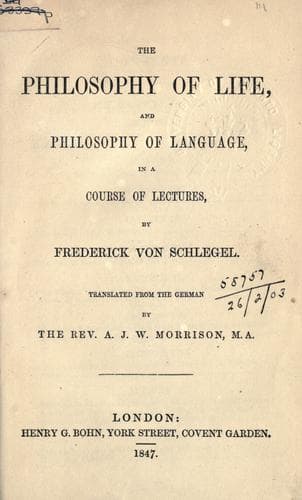
The philosophy of life, and philosophy of language, in a course of lecturesSchlegel, Friedrich von
Philosophy
The philosophy of life, and philosophy of language, in a course of lectures
Schlegel, Friedrich von
Language and languages -- Philosophy; Life; Philosophy
But let us now turn from the “_Absolute_” of reason to the personal God
of the believers among all peoples and times. If, now, the knowledge of
God be not a discovery of the reason, whose proper office is to analyze
and investigate--if, on the contrary, we are only able to understand of
Him so much as is given and imparted to us, then the matter assumes
quite another aspect. If God has conferred a knowledge of Himself upon
man--if He has spoken to him, has revealed Himself to him--as is the
common tradition of all ancient nations, the more unanimously
corroborated the older they are--then is the power to understand this
divine communication given together and at the same time with it, even
though we should be forced to allow that this intellectual capacity be
limited by human frailty and extremely imperfect. To take our estimate
of it as low as possible, we will conceive it to be something like the
degree of intelligence with which a child eighteen months old
understands its mother. Much it does not understand at all; other things
it mistakes, or perhaps does not fully attend to, and its answers, too,
are not much to the purpose; but something, nevertheless, it does
understand--this we see clearly enough. On this point we should not be
likely to be led astray, even though the theorist should wish to raise a
doubt on the matter, by attempting to prove that the child could not
properly understand its mother, since for that purpose it would be
necessary for it to have previously learned thoroughly and methodically
the elements of grammar. We believe, however, what, indeed, we see, that
man’s power of understanding divine things is really very imperfect. For
the relation between the child a year and a half old and its mother
completely represents that of man to God, with the more than
half-imperfect organs that are given him for this purpose--with his so
manifoldly limited mind or spirit, which is a spark of heavenly light,
indeed, but still only a spark--a drop out of the ocean of the infinite
whole--and, moreover, with his half-soul. For half-soul we may and must
call it in this respect, since with the one half it is turned to the
earth, and still wholly fraternizes with the sensible world; while with
the other it is directed to, and is percipient of, the divine. But such
a childlike and humble docility will not satisfy the proud reason, and
so it is ever turning again to the other absolute road of a false,
imaginary, and unhuman knowledge. Fundamentally, however, those two
words,[19] which alone man can be certain of with respect to God, would,
since God invariably imparts to every creature its due measure, be quite
enough, if only man would always rightly apply and faithfully preserve
them.
Public-domain text, read in full here on John Shaqi.
Reviews
Reviews
No reviews yet
Be the first to share your thoughts on this work.
Elsewhere in the archive
Join the Discussion
Join the discussion
Sign in to leave a comment or review.
Sign InorCreate an account