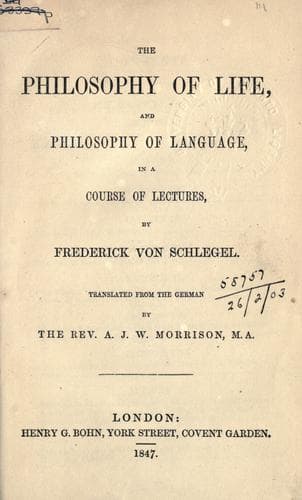
The philosophy of life, and philosophy of language, in a course of lecturesSchlegel, Friedrich von
Philosophy
The philosophy of life, and philosophy of language, in a course of lectures
Schlegel, Friedrich von
Language and languages -- Philosophy; Life; Philosophy
phenomena of nature and the atmosphere, when they are actually lowering
there, are to be got rid of by any such expedient.
It is only just and right, and not inconsistent with true human
knowledge, if physical science should commence with the study of man.
Still, if we would contemplate man from the side of nature, it seems the
safer course to endeavor, first of all, to obtain a clear and leading
idea of the whole of his constitution in this respect, rather than to
lose ourselves in the contemplation of the special phenomena of a
particular sphere. Now, with regard to the whole of man’s organization,
the organic body as the third constituent of human existence, I will
merely remark that, just as the triple principle of body, soul, and
spirit is repeated in the special and narrower spheres of the senses,
the instincts, and the passions, and even in the different forms in
which a disordered intellect usually manifests itself, so also it admits
of a further application to the organic body in general. That most
wonderful organization, the marvelous structure of bones and muscles,
the outward organic frame, is, as it were, the body in a narrower sense,
the pre-eminently material constituent of living bodies. The soul of
man--here consequently the organic soul--is in the blood and in the five
or six organs whose functions are first of all to elaborate the blood
and afterward to provide for its circulation--or perhaps by maintaining
a perpetual interchange of the breath and the external air, to keep the
vital flame constantly burning on the hearth of life within. A third
element--and, indeed, the principal one of the three, though only
noticeable in its effects on the brain--exists within the higher senses
and functions--in short, in the whole nervous tissue. But it lies not in
the nervous filaments themselves: anatomy can not detect it, for it is
not visible to the eye. On this account some have called it the æther of
the nerves to indicate its incorporeal nature--incorporeal, _i.e._,
relatively to, and in comparison with, the other two constituents of
man--the blood-soul, and the external frame--as being the spirit of life
in the organic body. Strictly and sharply enough does Holy Writ
distinguish this spiritual body (as it calls it) of man from the body of
the soul, or the organic blood-soul, considering the former, as it were,
the seed of the resurrection, even because at the moment of death this
ethereal body-of-light leaves its terrestrial veil to be in due time
reunited to it after a more glorious fashion. And death itself is even
nothing else than its total departure and painful emancipation from the
organic body, on which the features, one might almost say, the
physiognomy of corruption stamps itself, immediately that the immortal
Psyche, the invisible seed of light and eternity, has put off the
tabernacle of this body.
Public-domain text, read in full here on John Shaqi.
Reviews
Reviews
No reviews yet
Be the first to share your thoughts on this work.
Elsewhere in the archive
Join the Discussion
Join the discussion
Sign in to leave a comment or review.
Sign InorCreate an account