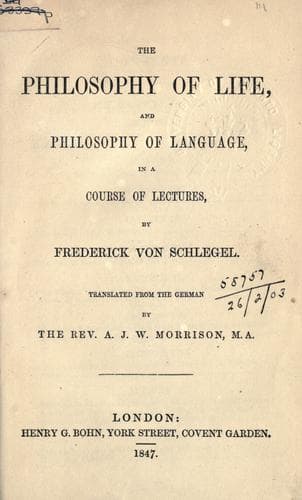
The philosophy of life, and philosophy of language, in a course of lecturesSchlegel, Friedrich von
Philosophy
The philosophy of life, and philosophy of language, in a course of lectures
Schlegel, Friedrich von
Language and languages -- Philosophy; Life; Philosophy
swallowed up by the sea.
Modern astronomy, at its first rise, was extremely revolting to man’s
feelings, which had become, as it were, habituated to the olden theory
of the world’s shape. The system of Ptolemy, indeed, with its narrow
egotistic conceit of making man the center of the sidereal universe, was
as unsatisfactory as it was absurd, and little was lost when it was
exploded. But, on the other hand, it was startling, and still has a
staggering effect on our minds, to be told, that, when measured by the
mathematical standard of the vast distances and periodic times of the
planetary system, the earth, for which the Almighty has done such
incalculably great things, and on which He has bestowed such high and
precious gifts, is, as it were, but a little and insignificant splinter
in the vast regions of infinite space. A true and profound science of
nature, however, does not allow of the validity of mathematical
magnitude as an exclusive standard of the value of things. Whether in a
greater or less sphere of existence, it sees and discovers in far other
properties the true center of life. If, even in our globe, the living
magnetic pole does not coincide with the true mathematical north pole,
but lies a considerable distance on one side of it, may it not, without
prejudice to modern astronomy, be also the case with the whole planetary
system? The first conceptions of nature are rarely, if ever, free from
mistakes, and oftentimes, together with great truths, contain also great
errors. And while the first fresh impression, the living intuition, ever
recommends itself to the general feeling of mankind, and takes deep root
therein, the notions, on the other hand, which new discoveries of nature
introduce, not unfrequently do violence to the prevalent views as to the
shape and form of the old world. Often, indeed, the former run directly
counter to what we might call the old family feelings of mankind, which,
transmitted through generations from father to son, have become, as it
were, a custom of life, a holy habit. Afterward, however, as the new
scientific discovery is more perfectly developed, it gradually
conciliates the old hereditary and customary feeling of nature. The two
at last fall into friendly relations with each other.
Public-domain text, read in full here on John Shaqi.
Reviews
Reviews
No reviews yet
Be the first to share your thoughts on this work.
Elsewhere in the archive
Join the Discussion
Join the discussion
Sign in to leave a comment or review.
Sign InorCreate an account