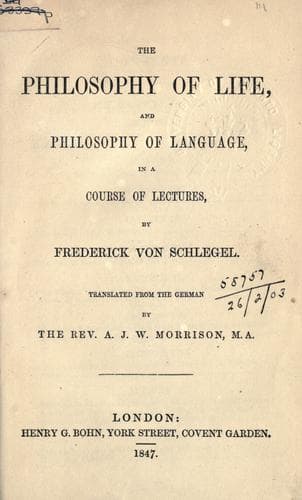
The philosophy of life, and philosophy of language, in a course of lecturesSchlegel, Friedrich von
Philosophy
The philosophy of life, and philosophy of language, in a course of lectures
Schlegel, Friedrich von
Language and languages -- Philosophy; Life; Philosophy
Now we know that in the pulse of the organic body its regular beating is
occasionally interrupted by a hurried circulation or a momentary
stoppage. Is it not in the same way possible that the pulsatory
revolutions of the great planetary world do not observe, like a piece of
dead clock-work, a mechanical uniformity, but are liable to many
deviations and irregularities? If, then, a similar stoppage to that
which sometimes occurs in the pulse of man, be here also supposable, as
produced by a superior power and external influence, then in the case of
such an extraordinary interruption, it is a matter of indifference
whether it be said of this wonderful moment that the sun stood still, or
(as seems to be the fact) that the earth was held in check and rested in
its orbit. And, in like manner, for the changing phenomena of the
astronomical day, the common expressions are equally true with the
scientific, and equally significant. The sun’s rise, the morning dawn,
is, for all men, a figure, or, rather, a fact of pregnant meaning, while
the setting sun fills all hearts with a melancholy feeling of
separation. Equally true, however, is it, and in a symbolical sense it
conveys perhaps a still more serious meaning, when we say, in scientific
language, “The earth must go down before the sun can rise;” or, “When
the earth goes up, then is it night, and darkness diffuses itself over
all.” Or if, perhaps, in the new and quickening spring, instead of the
old phraseology, “The sun has returned, has come near to us again,” we
were to say, “The earth, or at least our side of it, is again brought
nearer to the sun,” would it not be as beautiful and significant a
description? And happy, indeed, are those periods of the world wherein,
to speak in a figurative but moral sense, that earth-soul which rules in
the changes of time--the so-called public opinion, has declined toward,
and approached more nearly to, its sun.
Public-domain text, read in full here on John Shaqi.
Reviews
Reviews
No reviews yet
Be the first to share your thoughts on this work.
Elsewhere in the archive
Join the Discussion
Join the discussion
Sign in to leave a comment or review.
Sign InorCreate an account