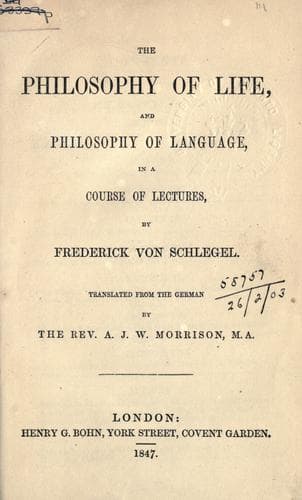
The philosophy of life, and philosophy of language, in a course of lecturesSchlegel, Friedrich von
Philosophy
The philosophy of life, and philosophy of language, in a course of lectures
Schlegel, Friedrich von
Language and languages -- Philosophy; Life; Philosophy
Now it is in nowise difficult to conceive of the human soul as much
simpler than it is, and apart from that division of it into several
faculties, which is at most, and properly, but an accident of its
existence. One of the first among the modern philosophers of Germany,
says somewhere of the soul, that the supposition of its existence is
superfluous, and that it is a pure fiction.[A] But this statement was
the result of his having abandoned in his system the true center of life
and consciousness; whoever, on the contrary, adheres steadily thereto,
will never concur in a position which simply, as contradicting the
general feeling of human nature, requires no elaborate refutation. But
as regards the two parts into which the soul is divided, viz., Reason
and Fancy--these, at any rate, are no fiction, but exist really and
truly within the consciousness, where, as in life itself, they often
stand confronting each other in hostile array. This division can not
well be called superfluous, but yet it does not admit of being
considered absolutely necessary, and belonging to the soul’s original
essence. If all thinking were a living cogitation--if the thinking and
the loving soul had remained at unity in their true center, then the
external methodical thought and the internal productive thinking,
meditating, and invention, would not be separate and divorced--at least
they would not come into hostile conflict with each other, but would
rather be harmoniously combined in the living cogitation of the loving
soul. The several forms, too, of a higher love and a higher endeavor,
aye, every lawful earthly inclination, would be blended in this harmony
of the soul, and no longer stand out as a separate and isolated faculty,
occasionally conflicting with all the others. Even the conscience would
no longer appear as a special act or function of the judgment, of a
distinct and peculiar kind, but would be absorbed in the whole as a
delicate internal sensibility and the pulse of the moral life.
Public-domain text, read in full here on John Shaqi.
Reviews
Reviews
No reviews yet
Be the first to share your thoughts on this work.
Elsewhere in the archive
Join the Discussion
Join the discussion
Sign in to leave a comment or review.
Sign InorCreate an account