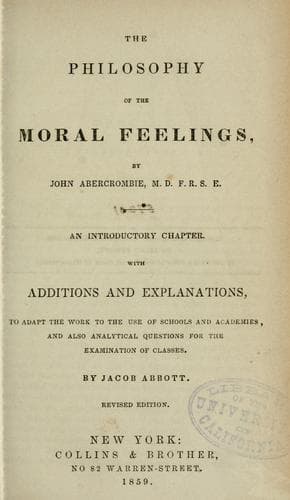
The Philosophy of the Moral FeelingsAbercrombie, John
Religion
The Philosophy of the Moral Feelings
Abercrombie, John
Ethics
Let us take the illustration of a man affected with a disease supposed
to be mortal;--he is told that a remedy has been discovered of
infallible efficacy; and that a person is at hand who is ready to
administer it. Does he perceive his danger;--does he believe the virtue
of the remedy;--does he confide in the sincerity of the individual who
offers it;--this is faith. The immediate and natural result of his faith
is, that he asks for the remedy which is offered;--and this result is
inseparable from such belief, according to the uniform sequence of
volitions in every sound mind. The man who professes to admit the facts,
and does not shew such a result of belief, professes what he does not
actually feel. If he perceives not the extent of his danger, he asks not
the remedy, because he values it not;--and the same effect may follow,
if he doubts either its efficacy, or the sincerity of him who offers it.
In this case, it is also to be observed, that a reflection is thrown
upon the character of this individual, by imputing to him an offer of
what he has either not the power or the intention to perform. But if the
man really believes the truths, he applies for the remedy; and he
receives it. Thus his faith saves him, because by means of it he bought
the offered aid. Could we suppose him merely to admit the facts, without
asking the remedy, his belief would avail him nothing.
Such appeals to be the simple view we are to take of Faith, when we
apply it to the great benefits which are presented to us in the
Christian revelation. This is addressed to us as beings in a state both
of guilt and of depravity; and as having no means of our own, by which
we can rescue ourselves from condemnation and impurity. It unfolds a
dispensation of peace, by which, in perfect consistency with the harmony
of his character, the Deity offers mercy and forgiveness,--and an
influence from himself which has power to purify the moral being. These
benefits are conferred on every one who believes; and who is he that
believes:--the man who is convinced of his guilt, and perceives his
impurity;--who feels his inability to rescue himself;--who admits the
efficacy of the remedy, and confides in the sincerity with which it is
offered;--this is he who believes. His faith saves him; because, acting
on his conviction, according to the uniform sequence of volitions in
every sound mind, he asks the promised aid, and asking receives it. Much
of the confusion, in which the subject has been involved, appears to
have arisen from metaphysical refinements, by which the various parts of
this mental process are separated from each other. They form one
harmonious whole, which cannot be broken. The man will not seek the
remedy, who believes not its efficacy, and perceives not his moral
necessities; but, however he may profess to admit these facts, if he
follows not out his belief to its natural result, by applying for the
remedy, his mere belief will not profit him. The grounds, on which
Public-domain text, read in full here on John Shaqi.
Reviews
Reviews
No reviews yet
Be the first to share your thoughts on this work.
Elsewhere in the archive
Join the Discussion
Join the discussion
Sign in to leave a comment or review.
Sign InorCreate an account