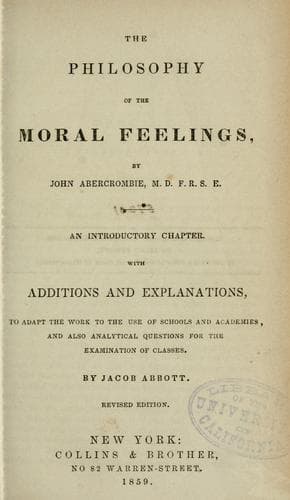
The Philosophy of the Moral FeelingsAbercrombie, John
Religion
The Philosophy of the Moral Feelings
Abercrombie, John
Ethics
The man, who acts habitually under the influence of these rules, learns
to question himself rigidly respecting the claims and duties which
result from his moral relations; and the feelings and circumstances of
those with whom they bring him into contact. What, (he asks himself) is
the line of action which belongs to me in regard to that
individual,--what are his feelings in his present situation,--what are
the feelings and conduct which he expects from me,--and what are those
which I would expect from him were I in his circumstances and he in
mine? It is not a due regulation of the affections alone that arises
from this wholesome state of mental discipline. It is a moral culture to
the mind itself, which may often be fraught with the most important
results. For the man who exercises it realizes to himself the feelings
of poverty,--the agonies of bereavement, the impressions of the bed of
death;--and thus, without the pain of suffering, he may reap a portion
of those important moral benefits which suffering is calculated to
yield.
There is another view still to be taken of the advantages derived from
that mental discipline which consists in attention to all the relations
included under the affections. When habitually exercised, it may often
bring before the mind important circumstances in our moral relations,
which are apt to make an inadequate impression amid the distractions of
present things. When the parent, for example, looks around the objects
of his tender affection, what a new impulse is communicated by the
thought, that the present life is but the infancy of their being; and
that his chief and highest concern is to train them for immortality. A
similar impulse must be given to the philanthropist, when he considers
that the individuals, who share his benevolent attentions, are, like
himself, passing through a scene of discipline to a higher state of
existence, where they will assume a place corresponding to their rank in
the scale of moral beings. The refined philanthropy thus arising, while
it neglects no proper attention to the distresses of the present life,
will seek chiefly to contend with those greater evils which degrade the
moral nature, and sever the immortal spirit from its God. He, who judges
upon this extended principle, will learn to form a new estimate of the
condition of man. Amid the pride of wealth and the splendour of power,
he may mourn over a being lost to every feeling of his high destiny;
and, by the death-bed of the peasant, amid discomfort and suffering, he
may contemplate with interest a purified spirit rising to immortality.
Public-domain text, read in full here on John Shaqi.
Reviews
Reviews
No reviews yet
Be the first to share your thoughts on this work.
Elsewhere in the archive
Join the Discussion
Join the discussion
Sign in to leave a comment or review.
Sign InorCreate an account