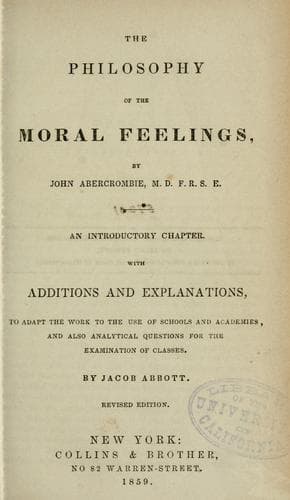
The Philosophy of the Moral FeelingsAbercrombie, John
Religion
The Philosophy of the Moral Feelings
Abercrombie, John
Ethics
II. Next to the power of attention, we have to notice the influence
produced upon the affections by Habit. This is founded upon a principle
of our nature, by which a remarkable relation exists between the
affections and the actions which arise out of them. The tendency of all
emotions is to become weaker by repetition, or to be less acutely felt
the oftener they are experienced. The tendency of actions, again, as we
have seen when treating of the Intellectual Powers, is to become easier
by repetition,--so that those, which at first require close and
continued attention, come to be performed without effort, and almost
without consciousness. Now an affection properly consists of an emotion
leading to an action; and the natural progress of the mind, in the
proper exercise of the affection, is, that the emotion becomes less
acutely felt, as the action becomes easier and more familiar.--Thus, a
scene of wretchedness, or a tale of sorrow, will produce in the
inexperienced an intensity of emotion not felt by him whose life has
been devoted to deeds of mercy; and a superficial observer is apt to
consider the condition of the latter as one of insensibility, produced
by familiarity with scenes of distress. It is, on the contrary, that
healthy and natural progress of the mind, in which the emotion is
gradually diminished in force as it is followed by its proper
actions,--that is, as the mere intensity of feeling is exchanged for the
habit of active benevolence. But that this may take place in the sound
and healthy manner, the emotion must be steadily followed by the action
which belongs to it. If this be neglected, the harmony of the moral
process is destroyed, and, as the emotion becomes weakened, it is
succeeded by cold insensibility or barren selfishness.
Public-domain text, read in full here on John Shaqi.
Reviews
Reviews
No reviews yet
Be the first to share your thoughts on this work.
Elsewhere in the archive
Join the Discussion
Join the discussion
Sign in to leave a comment or review.
Sign InorCreate an account