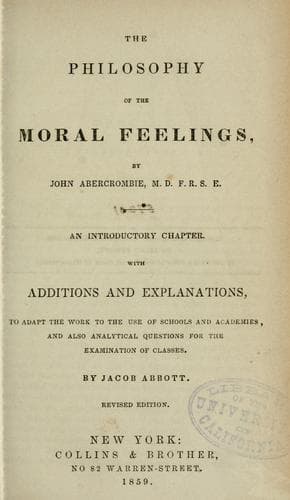
The Philosophy of the Moral FeelingsAbercrombie, John
Religion
The Philosophy of the Moral Feelings
Abercrombie, John
Ethics
A similar chain of sequences is to be observed respecting the operation
of those great truths, which, under the regulating power of conscience,
are calculated to act as moral causes in our mental economy;--we may
take, for example, the truths relating to the character and perfections
of the Deity, and the influence which these ought to produce upon every
rational being. We have seen the knowledge which we derive from the
light of nature respecting the attributes of God, when, from his works
around us, we discover him as a being of infinite power, wisdom, and
goodness; and when, from the moral impressions of our own minds, we
infer his perfections as a moral Governor of infinite holiness, justice,
and truth. By a proper direction of the mind to the truths which are
thus conveyed to us respecting the Deity, there would naturally arise a
corresponding chain of emotions of which he is the object. These are a
sense of veneration towards him, as infinitely great, wise, and
powerful,--of love and thankfulness, as infinitely good,--and of
habitual regard to his authority and will, as a moral governor of purity
and justice, and as requiring a corresponding character in all his
creatures. A close and constant relation ought to be preserved between
these truths and these emotions, and on this depends the moral harmony
of the mind. The preservation of this harmony, again, is intimately
connected with a mental process which every man feels to be
voluntary,--or in his power to perform, if he wills. It consists in a
careful direction of the mind to such truths, so as to enable them to
act as moral causes in the mental economy:--by the established order of
moral sequences, the emotions naturally follow:--these are then to be
cherished with satisfaction and reverence; and a corresponding influence
upon the character and conduct is the farther consequence. But the first
step in this important process may be neglected;--the mind may not be
directed with due care to the truths which thus claim its highest
regard,--and the natural result is a corresponding deficiency in the
emotions and conduct which ought to flow from them. This will be the
case in a still higher degree, if there has been formed any actual
derangement of the moral condition,--if deeds have been committed, or
even desires cherished, and mental habits acquired, by which the
indications of conscience have been violated. The moral harmony of the
mind is then lost, and, however slight may be the first impression, a
morbid influence has begun to operate in the mental economy, which tends
gradually to gain strength, until it becomes a ruling principle in the
whole character. The truths connected with the divine perfections are
now neither invited nor cherished, but are felt to be intruders which
disturb the mental tranquillity. The attention ceases to be directed to
them, and the corresponding emotions vanish from the mind. Such appears
Public-domain text, read in full here on John Shaqi.
Reviews
Reviews
No reviews yet
Be the first to share your thoughts on this work.
Elsewhere in the archive
Join the Discussion
Join the discussion
Sign in to leave a comment or review.
Sign InorCreate an account