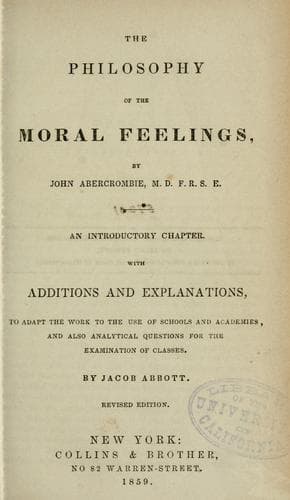
The Philosophy of the Moral FeelingsAbercrombie, John
Religion
The Philosophy of the Moral Feelings
Abercrombie, John
Ethics
To the principles which have now been stated, we are also to refer a
point in the philosophy of human nature which presents a subject of most
interesting reflection. I allude to the fact, that the great truths of
religious belief are so often rejected, by men who have acquired a
reputation for exalted powers of understanding in other departments of
intellectual inquiry. The fact is one of intense interest; and we can
scarcely wonder that superficial observers should have deduced from it
an impression, that it implies something defective in the evidence by
which these truths are proposed to our reception. But the conclusion is
entirely unwarranted, and the important principle cannot be too often
repeated, that the attainment of truth in moral inquiries is essentially
connected with the moral condition of the inquirer. On this depends the
anxious care with which he has directed his mind to the high pursuit,
under a deep and solemn feeling of its supreme importance. On this
depends the sincere and humble and candid love of truth with which he
has conducted it, apart alike from prejudice and frivolity. For without
these essential elements of character, the most exalted intellect may
fail of reaching the truth,--the most acute understanding may only
wander into delusion and falsehood.
* * * * *
Before concluding this subject, there is another point which deserves to
be alluded to;--namely, the influence produced upon all our moral
judgments and decisions by Attention. This important process of the mind
we have had occasion to mention in various parts of our inquiry. It
consists, as we have seen, in directing the thoughts, calmly and
deliberately, to all the facts and considerations by which we ought to
be influenced in the particular case which is under our view; and it
should be accompanied by an anxious and sincere desire to be guided,
both in our opinions and conduct, by the true and relative tendency of
each of them. It is a voluntary process of the mind which every man has
the power to perform; and on the degree in which it is habitually
exercised, depend some of the great differences between one man and
another in their moral condition. We have repeatedly had occasion to
mention that morbid state of the mind, in which moral causes seem to
have lost their proper influence, both on the volitions of the will, and
even on the conclusions of the judgment:--But it is a truth which cannot
be too often referred to, how much this condition is influenced by the
mental process which we are now considering. It originates, indeed, in
some degree of that distortion of moral feeling, in consequence of which
the inclinations wander from the strict path of rectitude;--but the
primary effect of this loss of mental harmony, and that by which it is
perpetuated, appears to be chiefly a habitual misdirection of the
attention,--or a total want of consideration of the truths and motives,
Public-domain text, read in full here on John Shaqi.
Reviews
Reviews
No reviews yet
Be the first to share your thoughts on this work.
Elsewhere in the archive
Join the Discussion
Join the discussion
Sign in to leave a comment or review.
Sign InorCreate an account