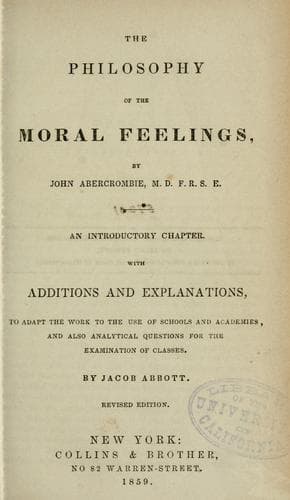
The Philosophy of the Moral FeelingsAbercrombie, John
Religion
The Philosophy of the Moral Feelings
Abercrombie, John
Ethics
with regard to the course which we here recognise as legitimate, much
caution is required, before we allow a process of the judgment to
interfere with the natural and healthy course of the moral feelings. If
the interference arises, not from a sound process of the understanding,
but from a course in which selfishness bears a considerable part, an
injurious influence upon the moral condition of the mind is the
necessary consequence. We thus perceive that, in the chain of sequences
relating to the benevolent feelings, there are three distinct
steps,--two of which are entirely under the control of the will. A man
has it entirely in his power to place himself in contact with objects of
distress, and to follow out the call of duty in considering their
circumstances, and entering into their feelings. The natural result is a
train of emotions which arise in his own mind, prompting him to a
particular line of conduct. To act upon these emotions is again under
the power of his will; and if the whole of this chain of sequences be
duly followed, the result is a sound condition of this part of the moral
economy. If either of the voluntary steps be neglected or violated, the
mental harmony is lost, and a habit is formed of unfeeling selfishness.
The principle, which has thus been illustrated by the benevolent
affections, is equally true of our other moral emotions. These emotions
are closely connected with certain truths, which are calculated to give
use to them, according to the constitution of our moral economy. Now,
the careful acquisition of the knowledge of these truths, and a serious
direction of the attention to their tendencies, are intellectual
processes which are as much under the power of our will, as are the acts
of visiting and giving attention to scenes of distress; and the due
cultivation of them involves an equal degree of moral responsibility.
This again is connected with the remarkable power which we possess over
the succession of our thoughts. We can direct the mind into a particular
train; we can continue it and dwell upon it with calm and deliberate
attention, so that the truths, which it brings before us, may produce
their natural and proper effect on our moral feelings. The emotions thus
excited lead to a certain line of conduct, which also is voluntary; and
on the due cultivation of this chain of sequences depends a healthy
moral condition. But we may neglect those parts of the sequence which
are under the control of our will. We may abstain from directing our
attention to such truths; we may view them in a slight, frivolous, or
distorted manner, or we may dismiss them altogether; and if any degree
of the emotions should be excited, we may make no effort towards the
cultivation of the conduct to which they would lead us. The due
cultivation of this power over the succession of our thoughts, is that
which constitutes one of the great differences between one man and
another, both as intellectual and moral beings;--and, though correct
Public-domain text, read in full here on John Shaqi.
Reviews
Reviews
No reviews yet
Be the first to share your thoughts on this work.
Elsewhere in the archive
Join the Discussion
Join the discussion
Sign in to leave a comment or review.
Sign InorCreate an account