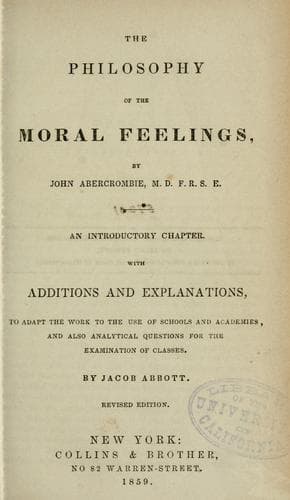
The Philosophy of the Moral FeelingsAbercrombie, John
Religion
The Philosophy of the Moral Feelings
Abercrombie, John
Ethics
The system of Mandeville ascribes our impressions of moral rectitude
entirely to the enactments of legislators. Man, he says, naturally seeks
only his own gratification, without any regard to the happiness of other
men. But legislators found that it would be necessary to induce him, in
some way, to surrender a position of his personal gratification for the
good of others, and so to promote the peace and harmony of society. To
accomplish this with such a selfish being, it was necessary to give him
some equivalent for the sacrifice he thus made; and the principle of his
nature which they fixed upon, for this purpose, was his love of praise.
They made certain laws for the general good, and then flattered mankind
into the belief that it was praiseworthy to observe them, and noble to
sacrifice a certain degree of their own gratification for the good of
others. What we call virtue thus resolves itself into the love of
praise. In regard to such a system as this, it has been thought
sufficient to point out the distinction between the immutable principles
of morality and those arrangements which are dependent upon mere
enactment. Such are many of the regulations and restrictions of
commerce. They are intended for the public good, and, while they are in
force, it is the duty of every good citizen to obey them. A change of
the law, however, changes their character, for they possess in
themselves none of the qualities of merit or demerit. But no laws can
alter, and no statutes modify, those great principles of moral conduct
which are graved indelibly on the conscience of all classes of men.
Kings, it has been said, may make laws, but cannot create a virtue.
By another modification of this system, our impressions of virtue and
vice are said to be derived entirely from mutual compact. Men, finding
that there was a certain course of action which would contribute to
their mutual advantage, and _vice versa_, entered into an agreement to
observe certain conduct, and abstain from certain other. The violation
of this compact constituted vice, the observance of it virtue.
By a theory, supported by some eminent men, as Clark and Wollaston,
virtue was considered to depend on a conformity of the conduct to a
certain sense of the fitness of things,--or the truth of things. The
meaning of this, it must be confessed, is rather obscure. It however
evidently refers the essence of virtue to a relation perceived by a
process of reason; and therefore may be held as at variance with the
belief of the impression being universal.
Public-domain text, read in full here on John Shaqi.
Reviews
Reviews
No reviews yet
Be the first to share your thoughts on this work.
Elsewhere in the archive
Join the Discussion
Join the discussion
Sign in to leave a comment or review.
Sign InorCreate an account