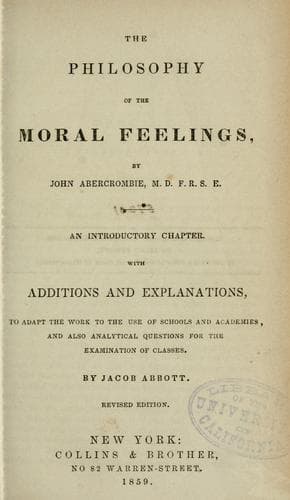
The Philosophy of the Moral FeelingsAbercrombie, John
Religion
The Philosophy of the Moral Feelings
Abercrombie, John
Ethics
We now come to the _Selfish System_ of morals, according to which the
fundamental principle of the conduct of mankind is a desire to promote
their own gratification or interest. This theory has appeared in
various forms, from a very early period in the history of Ethical
science; but the most remarkable promoter of it in more modern times was
Mr. Hobbes. According to him, man is influenced entirely by what seems
calculated, more immediately, or more remotely, to promote his own
interest; whatever does so, he considers as right,--the opposite as
wrong. He is driven to society by necessity, and then, whatever promotes
the general good, he considers as ultimately calculated to promote his
own. This system is founded upon a fallacy, similar to that referred to
under the former head. Virtuous conduct does impart gratification, and
that of the highest kind; and, in the strictest sense of the word, it
promotes the true interest of the agent, but this tendency is the
effect, not the cause; and never can be considered as the principle
which imparts to conduct its character of virtue; nor do we perform it
merely because it affords us gratification, or promotes our interest.
The hypothesis, indeed, may be considered as distinctly contradicted by
facts,--for, even in our own experience, it is clear, that the pleasure
attending an act of generosity or virtue in ourselves, as well as our
approbation of it in others, is diminished or destroyed by the
impression that there was a selfish purpose to answer by it.
There is a modification of the selfish system which attempts to get rid
of its more offensive aspect by a singular and circuitous chain of moral
emotions. We have experienced, it is said, that a certain attention to
the comfort or advantage of others contributes to our own. A kind of
habit is thus formed, by which we come at last to seek the happiness of
others for their own sake;--so that, by this process, actions, which at
first were considered only as inexpedient, from being opposed to
self-love, at length and insensibly come to be considered as immoral.
This can be considered as nothing more than an ingenious play upon
words, and deserves only to be mentioned as a historical fact, in a view
of those speculations by which this important subject has been obscured
and bewildered.
* * * * *
Public-domain text, read in full here on John Shaqi.
Reviews
Reviews
No reviews yet
Be the first to share your thoughts on this work.
Elsewhere in the archive
Join the Discussion
Join the discussion
Sign in to leave a comment or review.
Sign InorCreate an account