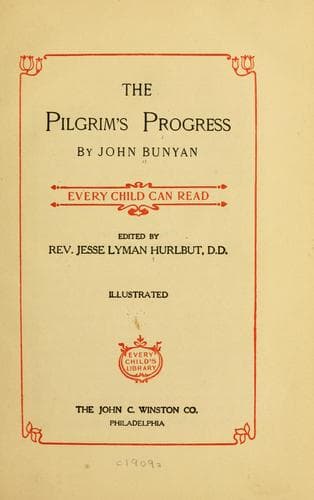
The Pilgrim's Progress by John Bunyan Every Child Can ReadBunyan, John
Religion
The Pilgrim's Progress by John Bunyan Every Child Can Read
Bunyan, John
Christian life -- Juvenile literature; Christian pilgrims and pilgrimages -- Juvenile literature
The Interpreter then replied, "This robin is an emblem very apt, to set
forth some people by; for to sight they are as this robin, pretty of
note, color, and conduct. They seem also to have a very great love for
those that are sincere followers of Christ; and above all other to
desire to associate with them, and to be in their company, as if they
could live upon the good man's crumbs. They pretend, also, that
therefore it is that they frequent the house of the godly and the
appointments of the Lord; but, when they are by themselves, as the
robin, they can catch and gobble up spiders, they can change their diet,
drink wickedness, and swallow down sin like water."
So, when they were come again into the house, because supper as yet was
not ready, Christiana again desired that the Interpreter would either
show, or tell of, some other things that were profitable.
Then the Interpreter began, and said, "The fatter the sow is the more
she desires the mire; the fatter the ox is, the more thoughtlessly he
goes to the slaughter; and the more healthy the lusty man is, the more
prone he is unto evil. There is a desire in women to go neat and fine;
and it is a comely thing to be adorned with that which in God's sight is
of great price. 'Tis easier watching a night or two than to sit up a
whole year together; so 'tis easier for one to begin to profess well
than to hold out as he should to the end. Every ship-master, when in a
storm, will willingly cast that overboard which is of the smallest value
in the vessel; but who will throw the best out first? None but he that
feareth not God. One leak will sink a ship, and one sin will destroy a
sinner. He that forgets his friends is ungrateful unto him but he that
forgets his Saviour is unmerciful to himself. He that lives in sin, and
looks for happiness hereafter, is like him that soweth weeds, and thinks
to fill his barn with wheat or barley. If a man would live well, let him
bring before him his last day, and make it always his company-keeper.
Whispering, and change of thoughts, prove that sin is in the world. If
the world, which God sets light by, is counted a thing of that worth
with men, what is heaven, that God commendeth! If the life that is
attended with so many troubles is so loth to be let go by us, what is
the life above! Everybody will cry up the goodness of men; but who is
there that is, as he should be, affected with the goodness of God?"
When the Interpreter had done, he takes them out into his garden again,
and had them to a tree, whose inside was all rotten and gone, and yet it
grew and had leaves.
Then said Mercy, "What means this?"
"This tree," said he, "whose outside is fair, and whose inside is
rotten, is that to which many may be compared that are in the garden of
God, who with their mouths speak high in behalf of God, but indeed will
do nothing for Him; whose leaves are fair, but their heart good for
nothing but to be tinder for the devil's tinder-box."
Public-domain text, read in full here on John Shaqi.
Reviews
Reviews
No reviews yet
Be the first to share your thoughts on this work.
Elsewhere in the archive
Join the Discussion
Join the discussion
Sign in to leave a comment or review.
Sign InorCreate an account