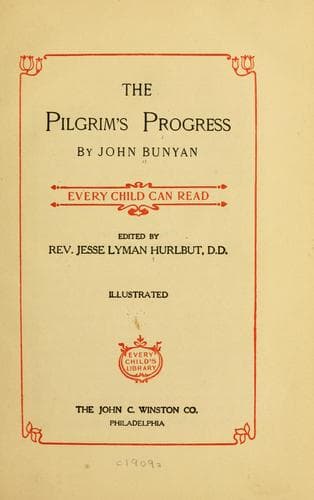
The Pilgrim's Progress by John Bunyan Every Child Can ReadBunyan, John
Religion
The Pilgrim's Progress by John Bunyan Every Child Can Read
Bunyan, John
Christian life -- Juvenile literature; Christian pilgrims and pilgrimages -- Juvenile literature
So the feeble and weak went in, and Mr. Great-heart and the rest did
follow. When they were also sat down, the shepherds said to those of the
weaker sort, "What is it that you would have? for," said they, "all
things must be managed here for the supporting of the weak, as well as
the warning of the unruly." So they made them a feast of things easy of
digestion, and that were pleasant to the palate, and nourishing; the
which when they had received, they went to their rest, each one
separately unto his proper place.
When morning was come, because the mountains were nigh and the day
clear, and because it was the custom of the shepherds to show the
pilgrims before their departure some rarities; therefore, after they
were ready and had refreshed themselves, the shepherds took them out
into the fields, and showed them first what they had showed to Christian
before.
Then they had them to some new places. The first was to Mount Marvel,
where they looked, and beheld a man at a distance that tumbled the hills
about with words. Then they asked the shepherds what that should mean.
So they told them that that man was the son of Mr. Great-grace of whom
you read in the first part of the records of the Pilgrim's Progress; and
he is set down there to teach the pilgrims how to believe, or to tumble
out of their ways what difficulties they should meet with, by faith.
Then said Mr. Great-heart, "I know him; he is a man above many."
Then they had them to another place, called Mount Innocent; and there
they saw a man clothed all in white, and two men, Prejudice and
Ill-will, continually casting dirt upon them. Now, behold, the dirt,
whatsoever they cast at him, would in a little time fall off again, and
his garment would look as clear as if no dirt had been cast thereat.
Then said the pilgrims, "What means this?"
The shepherds answered, "This man is named Godly-man, and this garment
is to show the innocency of his life. Now, those that throw dirt at him
are such as hate his well-doing; but, as you see, the dirt will not
stick upon his clothes: so it shall be with him that liveth truly
innocently in the world. Whoever they be that would make such men dirty,
they labor all in vain; for God, by that a little time is spent, will
cause that their innocence shall break forth as the light, and their
righteousness as the noon-day."
Then they took them, and had them to Mount Charity, where they showed
them a man that had a bundle of cloth lying before him, out of which he
cut coats and garments for the poor that stood about him; yet his bundle
or roll of cloth was never the less.
Then said they, "What should this be?"
"This is," said the shepherds, "to show you that he who has a heart to
give of his labor to the poor, shall never want wherewithal. He that
watereth shall be watered himself. And the cake that the widow gave to
the prophet did not cause that she had ever the less in her barrel."
Public-domain text, read in full here on John Shaqi.
Reviews
Reviews
No reviews yet
Be the first to share your thoughts on this work.
Elsewhere in the archive
Join the Discussion
Join the discussion
Sign in to leave a comment or review.
Sign InorCreate an account