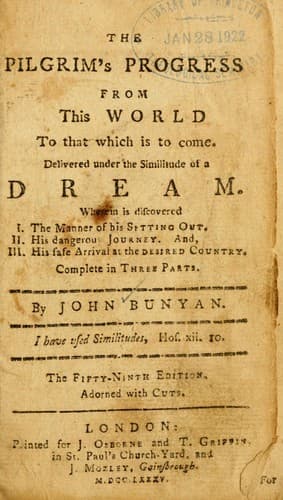
The Pilgrim's Progress from this world to that which is to come: Delivered under the similitude of a dream, by John BunyanBunyan, John
ReligionComparative
The Pilgrim's Progress from this world to that which is to come: Delivered under the similitude of a dream, by John Bunyan
Bunyan, John
Christian fiction; Christian pilgrims and pilgrimages -- Fiction
{226} Then a convenient time being appointed, they brought them
forth to their trial, in order to their condemnation. When the
time was come, they were brought before their enemies and arraigned.
The judge's name was Lord Hate-good. Their indictment was one and
the same in substance, though somewhat varying in form, the contents
whereof were this:--
{227} "That they were enemies to and disturbers of their trade;
that they had made commotions and divisions in the town, and had
won a party to their own most dangerous opinions, in contempt of
the law of their prince."
Now, FAITHFUL, play the man, speak for thy God:
Fear not the wicked's malice; nor their rod:
Speak boldly, man, the truth is on thy side:
Die for it, and to life in triumph ride.
{228} Faithful's answer for himself
Then Faithful began to answer, that he had only set himself against
that which hath set itself against Him that is higher than the
highest. And, said he, as for disturbance, I make none, being
myself a man of peace; the parties that were won to us, were won
by beholding our truth and innocence, and they are only turned from
the worse to the better. And as to the king you talk of, since he
is Beelzebub, the enemy of our Lord, I defy him and all his angels.
{229} Then proclamation was made, that they that had aught to say
for their lord the king against the prisoner at the bar, should
forthwith appear and give in their evidence. So there came in
three witnesses, to wit, Envy, Superstition, and Pickthank. They
were then asked if they knew the prisoner at the bar; and what they
had to say for their lord the king against him.
{230} Then stood forth Envy, and said to this effect: My Lord, I
have known this man a long time, and will attest upon my oath before
this honourable bench, that he is--
JUDGE. Hold! Give him his oath. (So they sware him.) Then he said--
ENVY. My Lord, this man, notwithstanding his plausible name, is
one of the vilest men in our country. He neither regardeth prince
nor people, law nor custom; but doth all that he can to possess all
men with certain of his disloyal notions, which he in the general
calls principles of faith and holiness. And, in particular, I
heard him once myself affirm that Christianity and the customs of
our town of Vanity were diametrically opposite, and could not be
reconciled. By which saying, my Lord, he doth at once not only
condemn all our laudable doings, but us in the doing of them.
JUDGE. Then did the Judge say to him, Hast thou any more to say?
ENVY. My Lord, I could say much more, only I would not be tedious
to the court. Yet, if need be, when the other gentlemen have given
in their evidence, rather than anything shall be wanting that will
despatch him, I will enlarge my testimony against him. So he was
bid to stand by. Then they called Superstition, and bid him look
upon the prisoner. They also asked, what he could say for their
lord the king against him. Then they sware him; so he began.
Public-domain text, read in full here on John Shaqi.
Reviews
Reviews
No reviews yet
Be the first to share your thoughts on this work.
Elsewhere in the archive
Join the Discussion
Join the discussion
Sign in to leave a comment or review.
Sign InorCreate an account