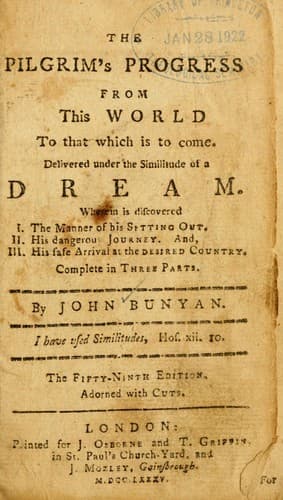
The Pilgrim's Progress from this world to that which is to come: Delivered under the similitude of a dream, by John BunyanBunyan, John
ReligionComparative
The Pilgrim's Progress from this world to that which is to come: Delivered under the similitude of a dream, by John Bunyan
Bunyan, John
Christian fiction; Christian pilgrims and pilgrimages -- Fiction
{236} 3. As to what Mr. Pickthank hath said, I say (avoiding terms,
as that I am said to rail, and the like) that the prince of this
town, with all the rabblement, his attendants, by this gentleman
named, are more fit for a being in hell, than in this town and
country: and so, the Lord have mercy upon me!
{237} Then the Judge called to the jury (who all this while stood
by, to hear and observe): Gentlemen of the jury, you see this man
about whom so great an uproar hath been made in this town. You
have also heard what these worthy gentlemen have witnessed against
him. Also you have heard his reply and confession. It lieth now
in your breasts to hang him or save his life; but yet I think meet
to instruct you into our law.
{238} There was an Act made in the days of Pharaoh the Great,
servant to our prince, that lest those of a contrary religion should
multiply and grow too strong for him, their males should be thrown
into the river. [Exo. 1:22] There was also an Act made in the
days of Nebuchadnezzar the Great, another of his servants, that
whosoever would not fall down and worship his golden image, should
be thrown into a fiery furnace. [Dan. 3:6] There was also an Act
made in the days of Darius, that whoso, for some time, called upon
any god but him, should be cast into the lions' den. [Dan. 6]
Now the substance of these laws this rebel has broken, not only
in thought, (which is not to be borne), but also in word and deed;
which must therefore needs be intolerable.
{239} For that of Pharaoh, his law was made upon a supposition, to
prevent mischief, no crime being yet apparent; but here is a crime
apparent. For the second and third, you see he disputeth against
our religion; and for the treason he hath confessed, he deserveth
to die the death.
Public-domain text, read in full here on John Shaqi.
Reviews
Reviews
No reviews yet
Be the first to share your thoughts on this work.
Elsewhere in the archive
Join the Discussion
Join the discussion
Sign in to leave a comment or review.
Sign InorCreate an account