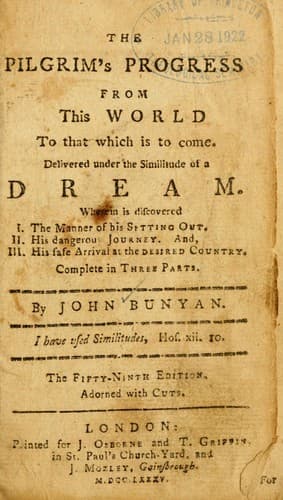
The Pilgrim's Progress from this world to that which is to come: Delivered under the similitude of a dream, by John BunyanBunyan, John
ReligionComparative
The Pilgrim's Progress from this world to that which is to come: Delivered under the similitude of a dream, by John Bunyan
Bunyan, John
Christian fiction; Christian pilgrims and pilgrimages -- Fiction
{252} HOLD-THE-WORLD. Ay, and hold you there still, good Mr.
By-ends; for, for my part, I can count him but a fool, that, having
the liberty to keep what he has, shall be so unwise as to lose it.
Let us be wise as serpents; it is best to make hay when the sun
shines; you see how the bee lieth still all winter, and bestirs her
only when she can have profit with pleasure. God sends sometimes
rain, and sometimes sunshine; if they be such fools to go through
the first, yet let us be content to take fair weather along with
us. For my part, I like that religion best that will stand with
the security of God's good blessings unto us; for who can imagine,
that is ruled by his reason, since God has bestowed upon us the
good things of this life, but that he would have us keep them for
his sake? Abraham and Solomon grew rich in religion. And Job
says, that a good man shall lay up gold as dust. But he must not
be such as the men before us, if they be as you have described
them.
SAVE-ALL. I think that we are all agreed in this matter, and
therefore there needs no more words about it.
MONEY-LOVE. No, there needs no more words about this matter, indeed;
for he that believes neither Scripture nor reason (and you see we
have both on our side) neither knows his own liberty, nor seeks
his own safety.
{253} BY-ENDS. My brethren, we are, as you see, going all on
pilgrimage; and, for our better diversion from things that are bad,
give me leave to propound unto you this question:--
Suppose a man, a minister, or a tradesman, &c., should have an
advantage lie before him, to get the good blessings of this life,
yet so as that he can by no means come by them except, in appearance
at least, he becomes extraordinarily zealous in some points
of religion that he meddled not with before, may he not use these
means to attain his end, and yet be a right honest man?
{254} MONEY-LOVE. I see the bottom of your question; and, with these
gentlemen's good leave, I will endeavour to shape you an answer.
And first, to speak to your question as it concerns a minister
himself: Suppose a minister, a worthy man, possessed but of a very
small benefice, and has in his eye a greater, more fat, and plump
by far; he has also now an opportunity of getting of it, yet so as
by being more studious, by preaching more frequently and zealously,
and, because the temper of the people requires it, by altering
of some of his principles; for my part, I see no reason but a man
may do this, (provided he has a call), ay, and more a great deal
besides, and yet be an honest man. For why--
{255} 1. His desire of a greater benefice is lawful, (this cannot
be contradicted), since it is set before him by Providence; so then,
he may get it, if he can, making no question for conscience' sake.
{256} 2. Besides, his desire after that benefice makes him more
studious, a more zealous preacher, &c., and so makes him a better
man; yea, makes him better improve his parts, which is according
to the mind of God.
Public-domain text, read in full here on John Shaqi.
Reviews
Reviews
No reviews yet
Be the first to share your thoughts on this work.
Elsewhere in the archive
Join the Discussion
Join the discussion
Sign in to leave a comment or review.
Sign InorCreate an account