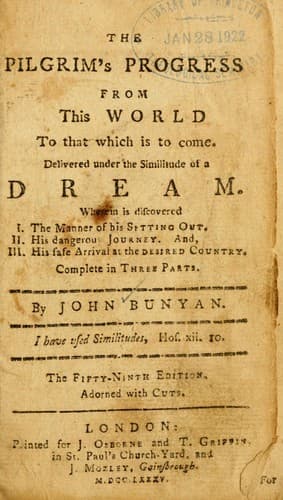
The Pilgrim's Progress from this world to that which is to come: Delivered under the similitude of a dream, by John BunyanBunyan, John
ReligionComparative
The Pilgrim's Progress from this world to that which is to come: Delivered under the similitude of a dream, by John Bunyan
Bunyan, John
Christian fiction; Christian pilgrims and pilgrimages -- Fiction
HOPE. There were several things brought it upon me, especially such
sayings as these: "All our righteousnesses are as filthy rags."
[Isa. 64:6] "By the works of the law shall no flesh be justified."
[Gal. 2:16] "When ye shall have done all those things, say, We are
unprofitable", [Luke 17:10] with many more such like. From whence
I began to reason with myself thus: If ALL my righteousnesses are
filthy rags; if, by the deeds of the law, NO man can be justified;
and if, when we have done ALL, we are yet unprofitable, then it
is but a folly to think of heaven by the law. I further thought
thus: If a man runs a hundred pounds into the shopkeeper's debt,
and after that shall pay for all that he shall fetch; yet, if this
old debt stands still in the book uncrossed, for that the shopkeeper
may sue him, and cast him into prison till he shall pay the debt.
CHR. Well, and how did you apply this to yourself?
HOPE. Why; I thought thus with myself. I have, by my sins, run a
great way into God's book, and that my now reforming will not pay
off that score; therefore I should think still, under all my present
amendments, But how shall I be freed from that damnation that I
have brought myself in danger of by my former transgressions?
{345} CHR. A very good application: but, pray, go on.
HOPE. Another thing that hath troubled me, even since my late
amendments, is, that if I look narrowly into the best of what I do
now, I still see sin, new sin, mixing itself with the best of that
I do; so that now I am forced to conclude, that notwithstanding
my former fond conceits of myself and duties, I have committed sin
enough in one duty to send me to hell, though my former life had
been faultless.
CHR. And what did you do then?
{346} HOPE. Do! I could not tell what to do, until I brake my
mind to Faithful, for he and I were well acquainted. And he told
me, that unless I could obtain the righteousness of a man that
never had sinned, neither mine own, nor all the righteousness of
the world could save me.
CHR. And did you think he spake true?
HOPE. Had he told me so when I was pleased and satisfied with mine
own amendment, I had called him fool for his pains; but now, since
I see mine own infirmity, and the sin that cleaves to my best
performance, I have been forced to be of his opinion.
{347} CHR. But did you think, when at first he suggested it to you,
that there was such a man to be found, of whom it might justly be
said that he never committed sin?
HOPE. I must confess the words at first sounded strangely, but
after a little more talk and company with him, I had full conviction
about it.
CHR. And did you ask him what man this was, and how you must be
justified by him?
Public-domain text, read in full here on John Shaqi.
Reviews
Reviews
No reviews yet
Be the first to share your thoughts on this work.
Elsewhere in the archive
Join the Discussion
Join the discussion
Sign in to leave a comment or review.
Sign InorCreate an account