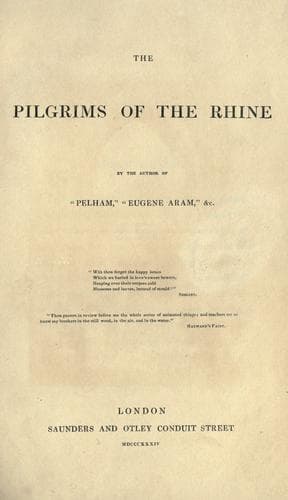
The Pilgrims of the RhineLytton, Edward Bulwer Lytton, Baron
Science
The Pilgrims of the Rhine
Lytton, Edward Bulwer Lytton, Baron
Fairies -- Fiction; Fantasy fiction; Rhine River Valley -- Fiction
“Fear not,” said the king, grasping the vessel; “none shall know: and,
behold, I will rise on the morrow; and my two sons, wrangling for my
crown--verily I shall be younger than they!”
Then the king laughed loud; and he scarcely thanked the servant of the
stars, neither did he promise him reward; for the kings in those days
had little thought save for themselves.
And Morven said to him, “Shall I not attend my lord?--for without me,
perchance, the drug might fail of its effect.”
“Ay,” said the king, “rest here.”
“Nay,” replied Morven; “thy servants will marvel and talk much, if they
see the son of Osslah sojourning in thy palace. So would the displeasure
of the gods of night perchance be incurred. Suffer that the lesser door
of the palace be unbarred, so that at the night hour, when the moon is
midway in the heavens, I may steal unseen into thy chamber, and mix the
liquid with thy wine.”
“So be it,” said the king. “Thou art wise, though thy limbs are crooked
and curt; and the stars might have chosen a taller man.” Then the king
laughed again; and Morven laughed too, but there was danger in the mirth
of the son of Osslah.
The night had begun to wane, and the inhabitants of Oestrich were buried
in deep sleep, when, hark! a sharp voice was heard crying out in the
streets, “Woe, woe! Awake, ye sons of Oestrich! woe!” Then forth, wild,
haggard, alarmed, spear in hand, rushed the giant sons of the rugged
tribe, and they saw a man on a height in the middle of the city,
shrieking “Woe!” and it was Morven, the son of Osslah! And he said unto
them, as they gathered round him, “Men and warriors, tremble as ye hear.
The star of the west hath spoken to me, and thus said the star: ‘Evil
shall fall upon the kingly house of Oestrich,--yea, ere the morning
dawn; wherefore, go thou mourning into the streets, and wake the
inhabitants to woe!’ So I rose and did the bidding of the star.” And
while Morven was yet speaking, a servant of the king’s house ran up
to the crowd, crying loudly, “The king is dead!” So they went into the
palace and found the king stark upon his couch, and his huge limbs all
cramped and crippled by the pangs of death, and his hands clenched as if
in menace of a foe,--the Foe of all living flesh! Then fear came on the
gazers, and they looked on Morven with a deeper awe than the boldest
warrior would have called forth; and they bore him back to the
council-hall of the wise men, wailing and clashing their arms in woe,
and shouting, ever and anon, “Honour to Morven the prophet!” And that
was the first time the word PROPHET was ever used in those countries.
At noon, on the third day from the king’s death, Siror sought Morven,
and he said, “Lo, my father is no more, and the people meet this evening
at sunset to elect his successor, and the warriors and the young men
will surely choose my brother, for he is more known in war. Fail me not
therefore.”
“Peace, boy!” said Morven, sternly; “nor dare to question the truth of
the gods of night.”
Public-domain text, read in full here on John Shaqi.
Reviews
Reviews
No reviews yet
Be the first to share your thoughts on this work.
Elsewhere in the archive
Join the Discussion
Join the discussion
Sign in to leave a comment or review.
Sign InorCreate an account