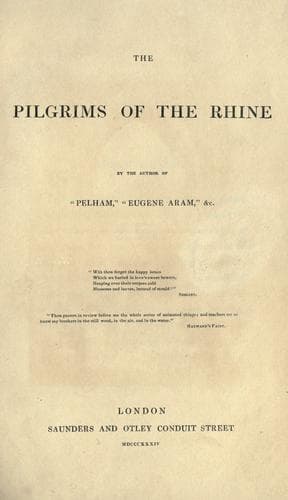
The Pilgrims of the RhineLytton, Edward Bulwer Lytton, Baron
Science
The Pilgrims of the Rhine
Lytton, Edward Bulwer Lytton, Baron
Fairies -- Fiction; Fantasy fiction; Rhine River Valley -- Fiction
And, lo! as the archangel spake, the stars beheld a young and
all-lustrous stranger on the throne of the erring star; and his face
was so soft to look upon that the dimmest of human eyes might have gazed
upon its splendour unabashed: but the dark fiend alone was dazzled
by its lustre, and, with a yell that shook the flaming pillars of the
universe, he plunged backward into the gloom.
Then, far and sweet from the arch unseen, came forth the voice of God,--
“Behold! on the throne of the discontented star sits the star of Hope;
and he that breathed into mankind the religion of Fear hath a successor
in him who shall teach earth the religion of Love!”
And evermore the star of Fear dwells with Lucifer, and the star of Love
keeps vigil in heaven!
CHAPTER XX. GLENHAUSEN.--THE POWER OF LOVE IN SANCTIFIED PLACES.--A
PORTRAIT OF FREDERICK BARBAROSSA.--THE AMBITION OF MEN FINDS NO ADEQUATE
SYMPATHY IN WOMEN.
“YOU made me tremble for you more than once,” said Gertrude to the
student; “I feared you were about to touch upon ground really sacred,
but your end redeemed all.”
“The false religion always tries to counterfeit the garb, the language,
the aspect of the true,” answered the German; “for that reason, I
purposely suffered my tale to occasion that very fear and anxiety you
speak of, conscious that the most scrupulous would be contented when the
whole was finished.”
This German was one of a new school, of which England as yet knows
nothing. We shall see hereafter what it will produce.
The student left them at Friedberg, and our travellers proceeded to
Glenhausen,--a spot interesting to lovers; for here Frederick the First
was won by the beauty of Gela, and, in the midst of an island vale, he
built the Imperial Palace, in honour of the lady of his love. This spot
is, indeed, well chosen of itself; the mountains of the Rhinegeburg
close it in with the green gloom of woods and the glancing waters of the
Kinz.
“Still, wherever we go,” said Trevylyan, “we find all tradition is
connected with love; and history, for that reason, hallows less than
romance.”
“It is singular,” said Vane, moralizing, “that love makes but a small
part of our actual lives, but is yet the master-key to our sympathies.
The hardest of us, who laugh at the passion when they see it palpably
before them, are arrested by some dim tradition of its existence in the
past. It is as if life had few opportunities of bringing out certain
qualities within us, so that they always remain untold and dormant,
susceptible to thought, but deaf to action.”
“You refine and mystify too much,” said Trevylyan, smiling; “none of
us have any faculty, any passion, uncalled forth, if we have _really_
loved, though but for a day.”
Gertrude smiled, and drawing her arm within his, Trevylyan left Vane to
philosophize on passion,--a fit occupation for one who had never felt
it.
Public-domain text, read in full here on John Shaqi.
Reviews
Reviews
No reviews yet
Be the first to share your thoughts on this work.
Elsewhere in the archive
Join the Discussion
Join the discussion
Sign in to leave a comment or review.
Sign InorCreate an account