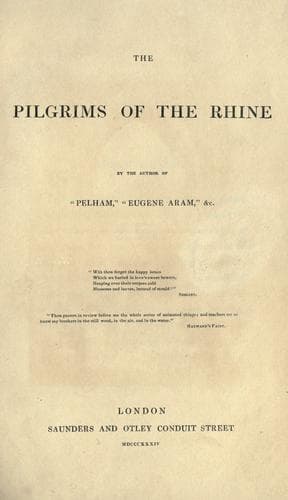
The Pilgrims of the RhineLytton, Edward Bulwer Lytton, Baron
Science
The Pilgrims of the Rhine
Lytton, Edward Bulwer Lytton, Baron
Fairies -- Fiction; Fantasy fiction; Rhine River Valley -- Fiction
They arrived at Trarbach late at noon. This now small and humble town
is said to have been the Thronus Bacchi of the ancients. From the spot
where the travellers halted to take, as it were, their impression of the
town, they saw before them the little hostelry, a poor pretender to the
Thronus Bacchi, with the rude sign of the Holy Mother over the door. The
peaked roof, the sunk window, the gray walls, checkered with the rude
beams of wood so common to the meaner houses on the Continent, bore
something of a melancholy and prepossessing aspect. Right above, with
its Gothic windows and venerable spire, rose the church of the town;
and, crowning the summit of a green and almost perpendicular mountain,
scowled the remains of one of those mighty castles which make the
never-failing frown on a German landscape.
The scene was one of quiet and of gloom: the exceeding serenity of the
day contrasted, with an almost unpleasing brightness, the poverty of
the town, the thinness of the population, and the dreary grandeur of the
ruins that overhung the capital of the perished race of the bold Counts
of Spanheim.
They passed the night at Trarbach, and continued their journey next
day. At Treves, Gertrude was for some days seriously ill; and when they
returned to Coblentz, her disease had evidently received a rapid and
alarming increase.
CHAPTER XXII. THE DOUBLE LIFE.--TREVYLYAN’S FATE.--SORROW THE PARENT OF
FAME.--NIEDERLAHNSTEIN.--DREAMS.
THERE are two lives to each of us, gliding on at the same time, scarcely
connected with each other,--the life of our actions, the life of our
minds; the external and the inward history; the movements of the frame,
the deep and ever-restless workings of the heart! They who have loved
know that there is a diary of the affections, which we might keep for
years without having occasion even to touch upon the exterior surface
of life, our busy occupations, the mechanical progress of our existence;
yet by the last are we judged, the first is never known. History reveals
men’s deeds, men’s outward character, but _not themselves_. There is a
secret self that hath its own life “rounded by a dream,” unpenetrated,
unguessed. What passed within Trevylyan, hour after hour, as he watched
over the declining health of the only being in the world whom his proud
heart had been ever destined to love? His real record of the time
was marked by every cloud upon Gertrude’s brow, every smile of her
countenance, every--the faintest--alteration in her disease; yet, to the
outward seeming, all this vast current of varying eventful emotion
lay dark and unconjectured. He filled up with wonted regularity the
colourings of existence, and smiled and moved as other men. For still,
in the heroism with which devotion conquers self, he sought only to
cheer and gladden the young heart on which he had embarked his all; and
he kept the dark tempest of his anguish for the solitude of night.
Public-domain text, read in full here on John Shaqi.
Reviews
Reviews
No reviews yet
Be the first to share your thoughts on this work.
Elsewhere in the archive
Join the Discussion
Join the discussion
Sign in to leave a comment or review.
Sign InorCreate an account