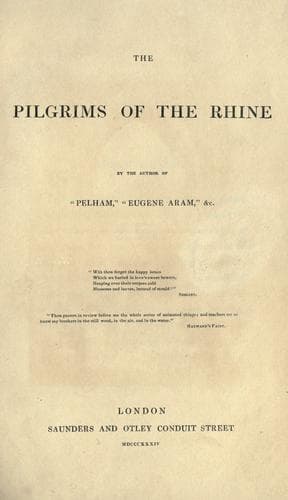
The Pilgrims of the RhineLytton, Edward Bulwer Lytton, Baron
Science
The Pilgrims of the Rhine
Lytton, Edward Bulwer Lytton, Baron
Fairies -- Fiction; Fantasy fiction; Rhine River Valley -- Fiction
“But I was afraid to call forth one shape on whose loveliness to pour
all the hidden passion of my soul. I trembled lest my sleep should
present me some image which it could never restore, and, waking from
which, even the new world I had created might be left desolate forever.
I shuddered lest I should adore a vision which the first ray of morning
could smite to the grave.
“In this train of mind I began to wonder whether it might not be
possible to connect dreams together; to supply the thread that was
wanting; to make one night continue the history of the other, so as
to bring together the same shapes and the same scenes, and thus lead a
connected and harmonious life, not only in the one half of existence,
but in the other, the richer and more glorious half. No sooner did this
idea present itself to me, than I burned to accomplish it. I had before
taught myself that Faith is the great creator; that to believe fervently
is to make belief true. So I would not suffer my mind to doubt the
practicability of its scheme. I shut myself up then entirely by day,
refused books, and hated the very sun, and compelled all my thoughts
(and sleep is the mirror of thought) to glide in one direction,--the
direction of my dreams,--so that from night to night the imagination
might keep up the thread of action, and I might thus lie down full of
the past dream and confident of the sequel. Not for one day only, or for
one month, did I pursue this system, but I continued it zealously and
sternly till at length it began to succeed. Who shall tell,” cried the
enthusiast,--I see him now with his deep, bright, sunken eyes, and his
wild hair thrown backward from his brow,--“the rapture I experienced,
when first, faintly and half distinct, I perceived the harmony I had
invoked dawn upon my dreams? At first there was only a partial and
desultory connection between them; my eye recognized certain shapes, my
ear certain tones common to each; by degrees these augmented in number,
and were more defined in outline. At length one fair face broke forth
from among the ruder forms, and night after night appeared mixing with
them for a moment and then vanishing, just as the mariner watches, in
a clouded sky, the moon shining through the drifting rack, and quickly
gone. My curiosity was now vividly excited; the face, with its lustrous
eyes and seraph features, roused all the emotions that no living shape
had called forth. I became enamoured of a dream, and as the statue to
the Cyprian was my creation to me; so from this intent and unceasing
passion I at length worked out my reward. My dream became more palpable;
I spoke with it; I knelt to it; my lips were pressed to its own; we
exchanged the vows of love, and morning only separated us with the
certainty that at night we should meet again. Thus then,” continued my
visionary, “I commenced a history utterly separate from the history of
the world, and it went on alternately with my harsh and chilling history
Public-domain text, read in full here on John Shaqi.
Reviews
Reviews
No reviews yet
Be the first to share your thoughts on this work.
Elsewhere in the archive
Join the Discussion
Join the discussion
Sign in to leave a comment or review.
Sign InorCreate an account