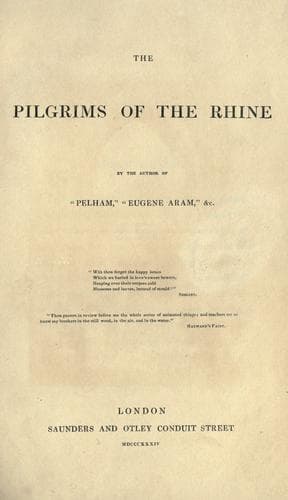
The Pilgrims of the RhineLytton, Edward Bulwer Lytton, Baron
Science
The Pilgrims of the Rhine
Lytton, Edward Bulwer Lytton, Baron
Fairies -- Fiction; Fantasy fiction; Rhine River Valley -- Fiction
As he entered the hall, he heard the voice of Leoline; she was singing
to the old chief one of the simple ballads of the time that the warrior
and the hunter loved to hear. He paused lest he should break the spell
(a spell stronger than a sorcerer’s to him), and gazing upon Leoline’s
beautiful form, his heart sank within him. His brother and himself
had each that day, as they sat in the gardens, given her a flower; his
flower was the fresher and the rarer; his he saw not, but she wore his
brother’s in her bosom!
The chief, lulled by the music and wearied with the toils of the chase,
sank into sleep as the song ended, and Warbeck, coming forward, motioned
to Leoline to follow him. He passed into a retired and solitary walk,
and when they were a little distance from the castle, Warbeck turned
round, and taking Leoline’s hand gently, said,--
“Let us rest here for one moment, dearest cousin; I have much on my
heart to say to thee.”
“And what is there,” answered Leoline, as they sat on a mossy bank,
with the broad Rhine glancing below, “what is there that my kind Warbeck
would ask of me? Ah, would it might be some favour, something in poor
Leoline’s power to grant; for ever from my birth you have been to me
most tender, most kind. You, I have often heard them say; taught my
first steps to walk; you formed my infant lips into language, and, in
after years, when my wild cousin was far away in the forests at the
chase, you would brave his gay jest and remain at home, lest Leoline
should be weary in the solitude. Ah, would I could repay you!”
Warbeck turned away his cheek; his heart was very full, and it was some
moments before he summoned courage to reply.
“My fair cousin,” said he, “those were happy days; but they were the
days of childhood. New cares and new thoughts have now come on us; but
I am still thy friend, Leoline, and still thou wilt confide in me thy
young sorrows and thy young hopes, as thou ever didst. Wilt thou not,
Leoline?”
“Canst thou ask me?” said Leoline; and Warbeck, gazing on her face, saw
that though her eyes were full of tears, they yet looked steadily upon
his; and he knew that she loved him only as a sister.
He sighed, and paused again ere he resumed. “Enough,” said he; “now to
my task. Once on a time, dear cousin, there lived among these mountains
a certain chief who had two sons, and an orphan like thyself dwelt also
in his halls. And the elder son--but no matter, let us not waste words
on _him_!--the younger son, then, loved the orphan dearly,--more dearly
than cousins love; and fearful of refusal, he prayed the elder one to
urge his suit to the orphan. Leoline, my tale is done. Canst thou not
love Otho as he loves thee?”
And now lifting his eyes to Leoline, he saw that she trembled violently,
and her cheek was covered with blushes.
“Say,” continued he, mastering himself, “is not that flower
his--present--a token that he is chiefly in thy thoughts?”
Public-domain text, read in full here on John Shaqi.
Reviews
Reviews
No reviews yet
Be the first to share your thoughts on this work.
Elsewhere in the archive
Join the Discussion
Join the discussion
Sign in to leave a comment or review.
Sign InorCreate an account