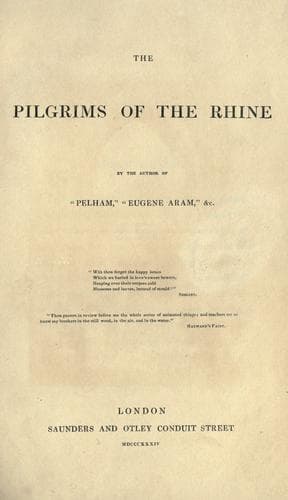
The Pilgrims of the RhineLytton, Edward Bulwer Lytton, Baron
Science
The Pilgrims of the Rhine
Lytton, Edward Bulwer Lytton, Baron
Fairies -- Fiction; Fantasy fiction; Rhine River Valley -- Fiction
These words turned all eyes to the figure, and they who sat next it
perceived that it trembled violently; at length it rose, and walking
slowly, but with grace, to the fair Greek, it laid beside her a wreath
of flowers.
“It is a simple gift, ladye,” said the stranger, in a voice of such
sweetness that the rudest guest was touched by it; “but it is all I can
offer, and the bride of Otho should not be without a gift at my hands.
May ye both be happy!”
With these words, the stranger turned and passed from the hall silent as
a shadow.
“Bring back the stranger!” cried the Greek, recovering her surprise.
Twenty guests sprang up to obey her mandate.
“No, no!” said Otho, waving his hand impatiently. “Touch her not, heed
her not, at your peril.”
The Greek bent over the flowers to conceal her anger, and from amongst
them dropped the broken half of a ring. Otho recognized it at once; it
was the broken half of that ring which he had broken with his betrothed.
Alas! he required not such a sign to convince him that that figure,
so full of ineffable grace, that touching voice, that simple action so
tender in its sentiment, that gift, that blessing, came only from the
forsaken and forgiving Leoline.
But Warbeck, alone in his solitary tower, paced to and fro with agitated
steps. Deep, undying wrath at his brother’s falsehood mingled with
one burning, one delicious hope. He confessed now that he had deceived
himself when he thought his passion was no more; was there any longer a
bar to his union with Leoline?
In that delicacy which was breathed into him by his love, he had
forborne to seek, or to offer her the insult of consolation. He felt
that the shock should be borne alone, and yet he pined, he thirsted, to
throw himself at her feet.
Nursing these contending thoughts, he was aroused by a knock at his
door; he opened it. The passage was thronged by Leoline’s maidens,
pale, anxious, weeping. Leoline had left the castle, with but one female
attendant, none knew whither; they knew too soon. From the hall of
Sternfels she had passed over in the dark and inclement night to the
valley in which the convent of Bornhofen offered to the weary of spirit
and the broken of heart a refuge at the shrine of God.
At daybreak the next morning, Warbeck was at the convent’s gate. He saw
Leoline. What a change one night of suffering had made in that face,
which was the fountain of all loveliness to him! He clasped her in his
arms; he wept; he urged all that love could urge: he besought her to
accept that heart which had never wronged her memory by a thought. “Oh,
Leoline! didst thou not say once that these arms nursed thy childhood;
that this voice soothed thine early sorrows? Ah, trust to them again
and forever. From a love that forsook thee turn to the love that never
swerved.”
Public-domain text, read in full here on John Shaqi.
Reviews
Reviews
No reviews yet
Be the first to share your thoughts on this work.
Elsewhere in the archive
Join the Discussion
Join the discussion
Sign in to leave a comment or review.
Sign InorCreate an account