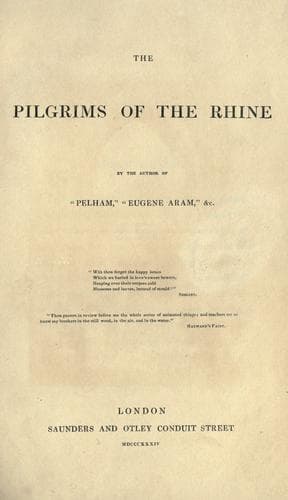
The Pilgrims of the RhineLytton, Edward Bulwer Lytton, Baron
Science
The Pilgrims of the Rhine
Lytton, Edward Bulwer Lytton, Baron
Fairies -- Fiction; Fantasy fiction; Rhine River Valley -- Fiction
“Cheer thee, my Nymphalin,” said the prince, “we will lay the tempest;”
and he waved his sword and muttered the charms which curb the winds and
roll back the marching thunder: but for once the tempest ceased not at
his spells. And now, as the fairies sped along the troubled air, a
pale and beautiful form met them by the way, and the fairies paused and
trembled; for the power of that Shape could vanquish even them. It
was the form of a Female, with golden hair, crowned with a chaplet of
withered leaves; her bosoms, of an exceeding beauty, lay bare to the
wind, and an infant was clasped between them, hushed into a sleep so
still, that neither the roar of the thunder, nor the livid lightning
flashing from cloud to cloud, could even ruffle, much less arouse, the
slumberer. And the face of the female was unutterably calm and sweet
(though with a something of severe); there was no line nor wrinkle in
the hueless brow; care never wrote its defacing characters upon that
everlasting beauty. It knew no sorrow or change; ghostlike and shadowy
floated on that Shape through the abyss of Time, governing the world
with an unquestioned and noiseless sway. And the children of the green
solitudes of the earth, the lovely fairies of my tale, shuddered as they
gazed and recognized--the form of DEATH,--death vindicated.
“And why,” said the beautiful Shape, with a voice soft as the last sighs
of a dying babe,--“why trouble ye the air with spells? Mine is the hour
and the empire, and the storm is the creature of my power. Far yonder to
the west it sweeps over the sea, and the ship ceases to vex the waves;
it smites the forest, and the destined tree, torn from its roots, feels
the winter strip the gladness from its boughs no more! The roar of the
elements is the herald of eternal stillness to their victims; and they
who hear the progress of my power idly shudder at the coming of peace.
And thou, O tender daughter of the fairy kings, why grievest thou at a
mortal’s doom? Knowest thou not that sorrow cometh with years, and that
to live is to mourn? Blessed is the flower that, nipped in its early
spring, feels not the blast that one by one scatters its blossoms around
it, and leaves but the barren stem. Blessed are the young whom I clasp
to my breast, and lull into the sleep which the storm cannot break, nor
the morrow arouse to sorrow or to toil. The heart that is stilled in the
bloom of its first emotions, that turns with its last throb to the eye
of love, as yet unlearned in the possibility of change,--has exhausted
already the wine of life, and is saved only from the lees. As the mother
soothes to sleep the wail of her troubled child, I open my arms to the
vexed spirit, and my bosom cradles the unquiet to repose!”
Public-domain text, read in full here on John Shaqi.
Reviews
Reviews
No reviews yet
Be the first to share your thoughts on this work.
Elsewhere in the archive
Join the Discussion
Join the discussion
Sign in to leave a comment or review.
Sign InorCreate an account