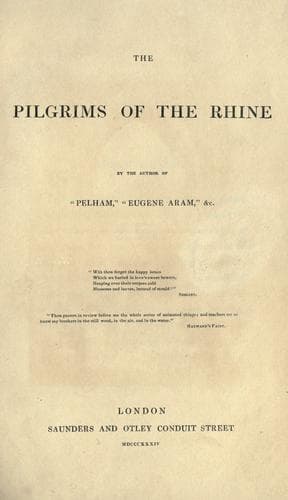
The Pilgrims of the RhineLytton, Edward Bulwer Lytton, Baron
Science
The Pilgrims of the Rhine
Lytton, Edward Bulwer Lytton, Baron
Fairies -- Fiction; Fantasy fiction; Rhine River Valley -- Fiction
Vane grew seriously alarmed; he repented that he had yielded to
Gertrude’s wish of substituting the Rhine for the Tiber or the Arno;
and would even now have hurried across the Alps to a warmer clime, if
Du-----e had not declared that she could not survive the journey,
and that her sole chance of regaining her strength was rest. Gertrude
herself, however, in the continued delusion of her disease, clung to
the belief of recovery, and still supported the hopes of her father, and
soothed, with secret talk of the future, the anguish of her betrothed.
The reader may remember that in the most touching passage in the
ancient tragedians, the most pathetic part of the most pathetic of
human poets--the pleading speech of Iphigenia, when imploring for
her prolonged life, she impresses you with so soft a picture of its
innocence and its beauty, and in this Gertrude resembled the Greek’s
creation--that she felt, on the verge of death, all the flush, the glow,
the loveliness of life. Her youth was filled with hope and many-coloured
dreams; she loved, and the hues of morning slept upon the yet
disenchanted earth. The heavens to her were not as the common sky;
the wave had its peculiar music to her ear, and the rustling leaves a
pleasantness that none whose heart is not bathed in the love and sense
of beauty could discern. Therefore it was, in future years, a thought
of deep gratitude to Trevylyan that she was so little sensible of her
danger; that the landscape caught not the gloom of the grave; and that,
in the Greek phrase, “death found her sleeping amongst flowers.”
At the end of a few days, another of those sudden turns, common to
her malady, occurred in Gertrude’s health; her youth and her happiness
rallied against the encroaching tyrant, and for the ensuing fortnight
she seemed once more within the bounds of hope. During this time they
made several excursions into the Rheingau, and finished their tour at
the ancient Heidelberg.
One morning, in these excursions, after threading the wood of
Niederwald, they gained that small and fairy temple, which hanging
lightly over the mountain’s brow, commands one of the noblest landscapes
of earth. There, seated side by side, the lovers looked over the
beautiful world below; far to the left lay the happy islets, in the
embrace of the Rhine, as it wound along the low and curving meadows that
stretch away towards Nieder-Ingelheim and Mayence. Glistening in the
distance, the opposite Nah swept by the Mause tower, and the ruins of
Klopp, crowning the ancient Bingen, into the mother tide. There, on
either side the town, were the mountains of St. Roch and Rupert, with
some old monastic ruin saddening in the sun. But nearer, below the
temple, contrasting all the other features of landscape, yawned a dark
and rugged gulf, girt by cragged elms and mouldering towers, the very
prototype of the abyss of time,--black and fathomless amidst ruin and
desolation.
Public-domain text, read in full here on John Shaqi.
Reviews
Reviews
No reviews yet
Be the first to share your thoughts on this work.
Elsewhere in the archive
Join the Discussion
Join the discussion
Sign in to leave a comment or review.
Sign InorCreate an account