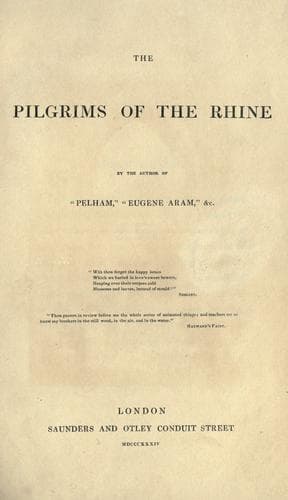
The Pilgrims of the RhineLytton, Edward Bulwer Lytton, Baron
Science
The Pilgrims of the Rhine
Lytton, Edward Bulwer Lytton, Baron
Fairies -- Fiction; Fantasy fiction; Rhine River Valley -- Fiction
Once Du-----e stopped the carriage in a spot of herbage, bedded among
the trees, and said to Gertrude, “We are now in one of the many places
along the Neckar which your favourite traditions serve to consecrate.
Amidst yonder copses, in the early ages of Christianity, there dwelt a
hermit, who, though young in years, was renowned for the sanctity of his
life. None knew whence he came, nor for what cause he had limited the
circle of life to the seclusion of his cell. He rarely spoke, save when
his ghostly advice or his kindly prayer was needed; he lived upon herbs,
and the wild fruits which the peasants brought to his cave; and every
morning and every evening he came to this spot to fill his pitcher from
the water of the stream. But here he was observed to linger long after
his task was done, and to sit gazing upon the walls of a convent which
then rose upon the opposite side of the bank, though now even its ruins
are gone. Gradually his health gave way beneath the austerities he
practised; and one evening he was found by some fishermen insensible on
the turf. They bore him for medical aid to the opposite convent; and one
of the sisterhood, the daughter of a prince, was summoned to attend
the recluse. But when his eyes opened upon hers, a sudden recognition
appeared to seize both. He spoke; and the sister threw herself on the
couch of the dying man, and shrieked forth a name, the most famous in
the surrounding country,--the name of a once noted minstrel, who, in
those rude times, had mingled the poet with the lawless chief, and was
supposed, years since, to have fallen in one of the desperate frays
between prince and outlaw, which were then common; storming the very
castle which held her, now the pious nun, then the beauty and presider
over the tournament and galliard. In her arms the spirit of the hermit
passed away. She survived but a few hours, and left conjecture busy with
a history to which it never obtained further clew. Many a troubadour in
later times furnished forth in poetry the details which truth refused to
supply; and the place where the hermit at sunrise and sunset ever came
to gaze upon the convent became consecrated by song.”
Public-domain text, read in full here on John Shaqi.
Reviews
Reviews
No reviews yet
Be the first to share your thoughts on this work.
Elsewhere in the archive
Join the Discussion
Join the discussion
Sign in to leave a comment or review.
Sign InorCreate an account