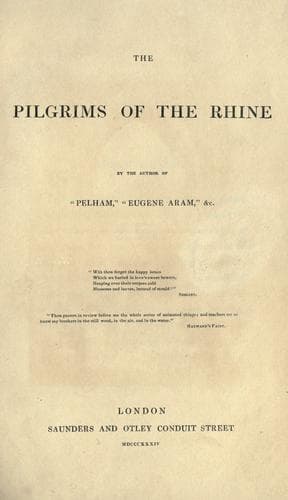
The Pilgrims of the RhineLytton, Edward Bulwer Lytton, Baron
Science
The Pilgrims of the Rhine
Lytton, Edward Bulwer Lytton, Baron
Fairies -- Fiction; Fantasy fiction; Rhine River Valley -- Fiction
Trevylyan, who had never loved this cold and unsusceptible man, save
for the sake of Gertrude, felt now almost a hatred creep over him, as he
thought in such a time, and with death fastening upon the flower of his
house, he could yet be calm, and smile, and muse, and moralize, and play
the common part of the world. He strode slowly up to him, and standing
full before him, said with a hollow voice and writhing smile, “You amuse
yourself pleasantly, sir: this is a fine scene; and to meditate over
griefs a thousand years hushed to rest is better than watching over a
sick girl and eating away your heart with fear!”
Vane looked at him quietly, but intently, and made no reply.
“Vane!” continued Trevylyan, with the same preternatural attempt at
calm, “Vane, in a few days all will be over, and you and I, the things,
the plotters, the false men of the world, will be left alone,--left by
the sole being that graces our dull life, that makes by her love either
of us worthy of a thought!”
Vane started, and turned away his face. “You are cruel,” said he, with a
faltering voice.
“What, man!” shouted Trevylyan, seizing him abruptly by the arm, “can
_you_ feel? Is your cold heart touched? Come then,” added he, with a
wild laugh, “come, let us be friends!”
Vane drew himself aside, with a certain dignity, that impressed
Trevylyan even at that hour. “Some years hence,” said he, “you will
be called cold as I am; sorrow will teach you the wisdom of
indifference--it is a bitter school, sir,--a bitter school! But think
you that I do indeed see unmoved my last hope shivered,--the last tie
that binds me to my kind? No, no! I feel it as a man may feel; I cloak
it as a man grown gray in misfortune should do! My child is more to
me than your betrothed to you; for you are young and wealthy, and life
smiles before you; but I--no more--sir, no more!”
“Forgive me,” said Trevylyan, humbly, “I have wronged you; but
Gertrude is an excuse for any crime of love; and now listen to my last
prayer,--give her to me, even on the verge of the grave. Death cannot
seize her in the arms, in the vigils of a love like mine.”
Vane shuddered. “It were to wed the dead,” said he. “No!”
Trevylyan drew back, and without another word, hurried away; he returned
to the town; he sought, with methodical calmness, the owner of the piece
of ground in which Gertrude had wished to be buried. He purchased it,
and that very night he sought the priest of a neighbouring church,
and directed it should be consecrated according to the due rite and
ceremonial.
The priest, an aged and pious man, was struck by the request, and the
air of him who made it.
“Shall it be done forthwith, sir?” said he, hesitating.
“Forthwith,” answered Trevylyan, with a calm smile,--“a bridegroom, you
know, is naturally impatient.”
Public-domain text, read in full here on John Shaqi.
Reviews
Reviews
No reviews yet
Be the first to share your thoughts on this work.
Elsewhere in the archive
Join the Discussion
Join the discussion
Sign in to leave a comment or review.
Sign InorCreate an account