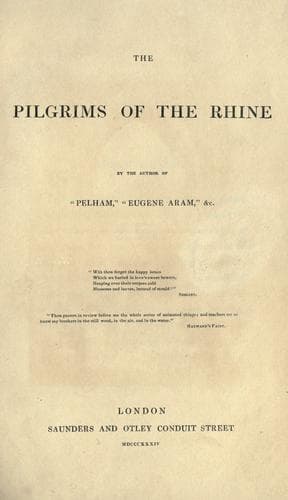
The Pilgrims of the RhineLytton, Edward Bulwer Lytton, Baron
Science
The Pilgrims of the Rhine
Lytton, Edward Bulwer Lytton, Baron
Fairies -- Fiction; Fantasy fiction; Rhine River Valley -- Fiction
Trevylyan, after a long sojourn on the Continent, returned to England.
He plunged into active life, and became what is termed in this age
of little names a distinguished and noted man. But what was mainly
remarkable in his future conduct was his impatience of rest. He
eagerly courted all occupations, even of the most varied and motley
kind,--business, letters, ambition, pleasure. He suffered no pause in
his career; and leisure to him was as care to others. He lived in
the world, as the worldly do, discharging its duties, fostering its
affections, and fulfilling its career. But there was a deep and wintry
change within him,--_the sunlight of his life was gone_; the loveliness
of romance had left the earth. The stem was proof as heretofore to the
blast, but the green leaves were severed from it forever, and the bird
had forsaken its boughs. Once he had idolized the beauty that is born of
song, the glory and the ardour that invest such thoughts as are not of
our common clay; but the well of enthusiasm was dried up, and the golden
bowl was broken at the fountain. With Gertrude the poetry of existence
was gone. As she herself had described her loss, a music had ceased to
breathe along the face of things; and though the bark might sail on as
swiftly, and the stream swell with as proud a wave, a something that
had vibrated on the heart was still, and the magic of the voyage was no
more.
And Gertrude sleeps on the spot where she wished her last couch to be
made; and far--oh, far dearer, is that small spot on the distant banks
of the gliding Neckar to Trevylyan’s heart than all the broad lands
and fertile fields of his ancestral domain. The turf too preserves its
emerald greenness; and it would seem to me that the field flowers spring
up by the sides of the simple tomb even more profusely than of old.
A curve in the bank breaks the tide of the Neckar; and therefore its
stream pauses, as if to linger reluctantly, by that solitary grave, and
to mourn among the rustling sedges ere it passes on. And I have thought,
when I last looked upon that quiet place, when I saw the turf so fresh,
and the flowers so bright of hue, that aerial hands might _indeed_
tend the sod; that it was by no _imaginary_ spells that I summoned
the fairies to my tale; that in truth, and with vigils constant though
unseen, they yet kept from all polluting footsteps, and from the harsher
influence of the seasons, the grave of one who so loved their race;
and who, in her gentle and spotless virtue claimed kindred with the
beautiful Ideal of the world. Is there one of us who has not known some
being for whom it seemed not too wild a fantasy to indulge such dreams?
THE END.
End of Project Gutenberg’s The Pilgrims Of The Rhine, by Edward Bulwer-Lytton
Public-domain text, read in full here on John Shaqi.
Reviews
Reviews
No reviews yet
Be the first to share your thoughts on this work.
Elsewhere in the archive
Join the Discussion
Join the discussion
Sign in to leave a comment or review.
Sign InorCreate an account