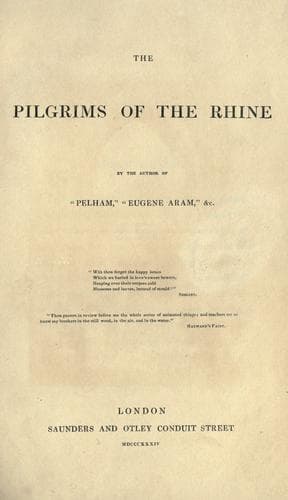
The Pilgrims of the RhineLytton, Edward Bulwer Lytton, Baron
Science
The Pilgrims of the Rhine
Lytton, Edward Bulwer Lytton, Baron
Fairies -- Fiction; Fantasy fiction; Rhine River Valley -- Fiction
presence of a puppet; he feels it, and is mean; he expresses it, and
is ludicrous. It is well to say that great minds will not stoop to
jealousy; in the greatest minds, it is most frequent.* Few authors are
ever so aware of the admiration they excite as to afford to be generous;
and this melancholy truth revolts us with our own ambition. Shall we be
demigods in our closets at the price of sinking below mortality in the
world? No! it was from this deep sentiment of the unrealness of literary
fame, of dissatisfaction at the fruits it produced, of fear for the
meanness it engendered, that I resigned betimes all love for its career;
and if, by the restless desire that haunts men who think much to write
ever, I should be urged hereafter to literature, I will sternly teach
myself to persevere in the indifference to its fame.”
* See the long list of names furnished by Disraeli, in that most
exquisite work, “The Literary Character,” vol. ii. p. 75. Plato,
Xenophon, Chaucer, Corneille, Voltaire, Dryden, the Caracci,
Domenico Venetiano, murdered by his envious friend, and the gentle
Castillo fainting away at the genius of Murillo.
“You say as I would say,” answered Vane, with his tranquil smile; “and
your experience corroborates my theory. Ambition, then, is not the root
of happiness. Why more in action than in letters?”
“Because,” said Trevylyan, “in action we commonly gain in our life all
the honour we deserve: the public judge of men better and more rapidly
than of books. And he who takes to himself in action a high and pure
ambition, associates it with so many objects, that, unlike literature,
the failure of one is balanced by the success of the other. He, the
creator of deeds, not resembling the creator of books, stands not alone;
he is eminently social; he has many comrades, and without their aid
he could not accomplish his designs. This divides and mitigates the
impatient jealousy against others. He works for a cause, and knows early
that he cannot monopolize its whole glory; he shares what he is aware
it is impossible to engross. Besides, action leaves him no time for
brooding over disappointment. The author has consumed his youth in a
work,--it fails in glory. Can he write another work? Bid him call back
another youth! But in action, the labour of the mind is from day to day.
A week replaces what a week has lost, and all the aspirant’s fame is of
the present. It is lipped by the Babel of the living world; he is
ever on the stage, and the spectators are ever ready to applaud. Thus
perpetually in the service of others self ceases to be his world; he has
no leisure to brood over real or imaginary wrongs; the excitement whirls
on the machine till it is worn out--”
“And kicked aside,” said Vane, “with the broken lumber of men’s other
tools, in the chamber of their son’s forgetfulness. Your man of action
lasts but for an hour; the man of letters lasts for ages.”
Public-domain text, read in full here on John Shaqi.
Reviews
Reviews
No reviews yet
Be the first to share your thoughts on this work.
Join the Discussion
Join the discussion
Sign in to leave a comment or review.
Sign InorCreate an account