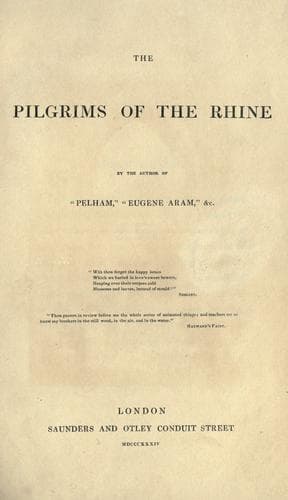
The Pilgrims of the RhineLytton, Edward Bulwer Lytton, Baron
Science
The Pilgrims of the Rhine
Lytton, Edward Bulwer Lytton, Baron
Fairies -- Fiction; Fantasy fiction; Rhine River Valley -- Fiction
“So you see, Gertrude, that even the Virtues may fall at loggerheads
with each other, and pass a very sad time of it, if they happen to be
of opposite dispositions, and have forgotten to take Good Temper with
them.”
“Ah,” said Gertrude, “but you have overloaded your boat; too many
Virtues might contradict one another, but not a few.”
“Voila ce que veux dire,” said Vane; “but listen to the sequel of my
tale, which now takes a new moral.”
At the end of the voyage, and after a long, sulky silence, Prudence
said, with a thoughtful air, “My dear friends, I have been thinking that
as long as we keep so entirely together, never mixing with the rest of
the world, we shall waste our lives in quarrelling amongst ourselves and
run the risk of being still less liked and sought after than we already
are. You know that we are none of us popular; every one is quite
contented to see us represented in a vaudeville, or described in an
essay. Charity, indeed, has her name often taken in vain at a bazaar
or a subscription; and the miser as often talks of the duty he owes to
_me_, when he sends the stranger from his door or his grandson to jail:
but still we only resemble so many wild beasts, whom everybody likes
to see but nobody cares to possess. Now, I propose that we should all
separate and take up our abode with some mortal or other for a year,
with the power of changing at the end of that time should we not feel
ourselves comfortable,--that is, should we not find that we do all the
good we intend; let us try the experiment, and on this day twelvemonths
let us all meet under the largest oak in Windsor Forest, and recount
what has befallen us.” Prudence ceased, as she always does when she has
said enough; and, delighted at the project, the Virtues agreed to
adopt it on the spot. They were enchanted at the idea of setting up for
themselves, and each not doubting his or her success,--for Economy in
her heart thought Generosity no Virtue at all, and Meekness looked on
Courage as little better than a heathen.
Generosity, being the most eager and active of all the Virtues, set off
first on his journey. Justice followed, and kept up with him, though at
a more even pace. Charity never heard a sigh, or saw a squalid face, but
she stayed to cheer and console the sufferer,--a kindness which somewhat
retarded her progress.
Public-domain text, read in full here on John Shaqi.
Reviews
Reviews
No reviews yet
Be the first to share your thoughts on this work.
Elsewhere in the archive
Join the Discussion
Join the discussion
Sign in to leave a comment or review.
Sign InorCreate an account