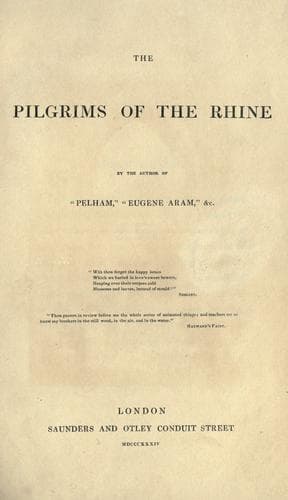
The Pilgrims of the RhineLytton, Edward Bulwer Lytton, Baron
Science
The Pilgrims of the Rhine
Lytton, Edward Bulwer Lytton, Baron
Fairies -- Fiction; Fantasy fiction; Rhine River Valley -- Fiction
Courage espied a travelling carriage, with a man and his wife in it
quarrelling most conjugally, and he civilly begged he might be permitted
to occupy the vacant seat opposite the lady. Economy still lingered,
inquiring for the cheapest inns. Poor Modesty looked round and sighed,
on finding herself so near to London, where she was almost wholly
unknown; but resolved to bend her course thither for two reasons:
first, for the novelty of the thing; and, secondly, not liking to expose
herself to any risks by a journey on the Continent. Prudence, though
the first to project, was the last to execute; and therefore resolved to
remain where she was for that night, and take daylight for her travels.
The year rolled on, and the Virtues, punctual to the appointment, met
under the oak-tree; they all came nearly at the same time, excepting
Economy, who had got into a return post-chaise, the horses to which,
having been forty miles in the course of the morning, had foundered by
the way, and retarded her journey till night set in. The Virtues looked
sad and sorrowful, as people are wont to do after a long and fruitless
journey; and, somehow or other, such was the wearing effect of their
intercourse with the world, that they appeared wonderfully diminished in
size.
“Ah, my dear Generosity,” said Prudence, with a sigh, “as you were
the first to set out on your travels, pray let us hear your adventures
first.”
“You must know, my dear sisters,” said Generosity, “that I had not gone
many miles from you before I came to a small country town, in which a
marching regiment was quartered, and at an open window I beheld, leaning
over a gentleman’s chair, the most beautiful creature imagination ever
pictured; her eyes shone out like two suns of perfect happiness, and she
was almost cheerful enough to have passed for Good Temper herself. The
gentleman over whose chair she leaned was her husband; they had been
married six weeks; he was a lieutenant with one hundred pounds a
year besides his pay. Greatly affected by their poverty, I instantly
determined, without a second thought, to ensconce myself in the heart
of this charming girl. During the first hour in my new residence I made
many wise reflections such as--that Love never was so perfect as when
accompanied by Poverty; what a vulgar error it was to call the unmarried
state ‘Single _Blessedness_;’ how wrong it was of us Virtues never to
have tried the marriage bond; and what a falsehood it was to say that
husbands neglected their wives, for never was there anything in nature
so devoted as the love of a husband--six weeks married!
Public-domain text, read in full here on John Shaqi.
Reviews
Reviews
No reviews yet
Be the first to share your thoughts on this work.
Elsewhere in the archive
Join the Discussion
Join the discussion
Sign in to leave a comment or review.
Sign InorCreate an account