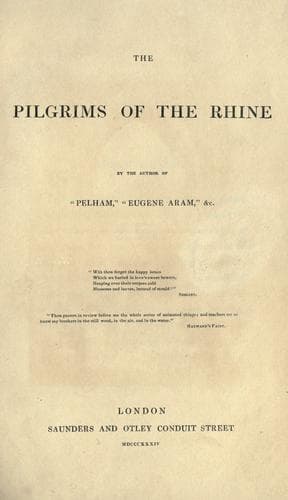
The Pilgrims of the RhineLytton, Edward Bulwer Lytton, Baron
Science
The Pilgrims of the Rhine
Lytton, Edward Bulwer Lytton, Baron
Fairies -- Fiction; Fantasy fiction; Rhine River Valley -- Fiction
absurdity, for by such names had they the impertinence to call _me_.
Thus grieved to the soul to find myself the cause of all poor Fanny’s
misfortunes, I resolved at the end of the year to leave her, being
thoroughly convinced that, however amiable and praiseworthy I might be
in myself, I was totally unfit to be bosom friend and adviser to the
wife of a lieutenant in a marching regiment, with only one hundred
pounds a year besides his pay.”
The Virtues groaned their sympathy with the unfortunate Fanny; and
Prudence, turning to Justice, said, “I long to hear what you have been
doing, for I am certain you cannot have occasioned harm to any one.”
Justice shook her head and said: “Alas! I find that there are times and
places when even I do better not to appear, as a short account of my
adventures will prove to you. No sooner had I left you than I instantly
repaired to India, and took up my abode with a Brahmin. I was much
shocked by the dreadful inequalities of condition that reigned in
the several castes, and I longed to relieve the poor Pariah from his
ignominious destiny; accordingly I set seriously to work on reform.
I insisted upon the iniquity of abandoning men from their birth to an
irremediable state of contempt, from which no virtue could exalt them.
The Brahmins looked upon my Brahmin with ineffable horror. They called
_me_ the most wicked of vices; they saw no distinction between Justice
and Atheism. I uprooted their society--that was sufficient crime. But
the worst was, that the Pariahs themselves regarded me with suspicion;
they thought it unnatural in a Brahmin to care for a Pariah! And one
called me ‘Madness,’ another, ‘Ambition,’ and a third, ‘The Desire to
innovate.’ My poor Brahmin led a miserable life of it; when one day,
after observing, at my dictation, that he thought a Pariah’s life as
much entitled to respect as a cow’s, he was hurried away by the priests
and secretly broiled on the altar as a fitting reward for his sacrilege.
I fled hither in great tribulation, persuaded that in some countries
even Justice may do harm.”
“As for me,” said Charity, not waiting to be asked, “I grieve to say
that I was silly enough to take up my abode with an old lady in Dublin,
who never knew what discretion was, and always acted from impulse;
my instigation was irresistible, and the money she gave in her drives
through the suburbs of Dublin was so lavishly spent that it kept all
the rascals of the city in idleness and whiskey. I found, to my great
horror, that I was a main cause of a terrible epidemic, and that to give
alms without discretion was to spread poverty without help. I left the
city when my year was out, and as ill-luck would have it, just at the
time when I was most wanted.”
“And oh,” cried Hospitality, “I went to Ireland also. I fixed my abode
with a squireen; I ruined him in a year, and only left him because he
had no longer a hovel to keep me in.”
Public-domain text, read in full here on John Shaqi.
Reviews
Reviews
No reviews yet
Be the first to share your thoughts on this work.
Elsewhere in the archive
Join the Discussion
Join the discussion
Sign in to leave a comment or review.
Sign InorCreate an account