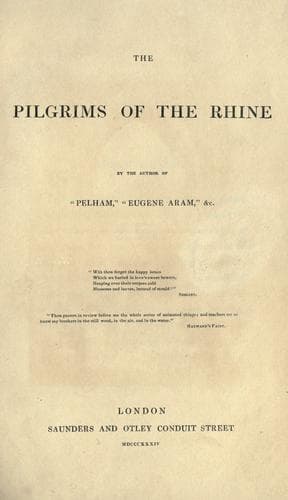
The Pilgrims of the RhineLytton, Edward Bulwer Lytton, Baron
Science
The Pilgrims of the Rhine
Lytton, Edward Bulwer Lytton, Baron
Fairies -- Fiction; Fantasy fiction; Rhine River Valley -- Fiction
“The next morning, before breakfast, as the charming Fanny was
waiting for her husband, who had not yet finished his toilet, a poor,
wretched-looking object appeared at the window, tearing her hair and
wringing her hands; her husband had that morning been dragged to prison,
and her seven children had fought for the last mouldy crust. Prompted
by me, Fanny, without inquiring further into the matter, drew from her
silken purse a five-pound note, and gave it to the beggar, who departed
more amazed than grateful. Soon after, the lieutenant appeared. ‘What
the devil, another bill!’ muttered he, as he tore the yellow wafer from
a large, square, folded, bluish piece of paper. ‘Oh, ah! confound the
fellow, _he_ must be paid. I must trouble you, Fanny, for fifteen pounds
to pay this saddler’s bill.’
“‘Fifteen pounds, love?’ stammered Fanny, blushing.
“‘Yes, dearest, the fifteen pounds I gave you yesterday.’
“‘I have only ten pounds,’ said Fanny, hesitatingly; ‘for such a poor,
wretched-looking creature was here just now, that I was obliged to give
her five pounds.’
“‘Five pounds? good Heavens!’ exclaimed the astonished husband; ‘I shall
have no more money this three weeks.’ He frowned, he bit his lips, nay,
he even wrung his hands, and walked up and down the room; worse still,
he broke forth with--‘Surely, madam, you did not suppose, when you
married a lieutenant in a marching regiment, that he could afford to
indulge in the whim of giving five pounds to every mendicant who held
out her hand to you? You did not, I say, madam, imagine’--but the
bridegroom was interrupted by the convulsive sobs of his wife: it was
their first quarrel, they were but six weeks married; he looked at
her for one moment sternly, the next he was at her feet. ‘Forgive me,
dearest Fanny,--forgive me, for I cannot forgive myself. I was too great
a wretch to say what I did; and do believe, my own Fanny, that while
I may be too poor to indulge you in it, I do from my heart admire so
noble, so disinterested, a generosity.’ Not a little proud did I feel
to have been the cause of this exemplary husband’s admiration for his
amiable wife, and sincerely did I rejoice at having taken up my abode
with these _poor_ people. But not to tire you, my dear sisters, with the
minutiae of detail, I shall briefly say that things did not long remain
in this delightful position; for before many months had elapsed, poor
Fanny had to bear with her husband’s increased and more frequent
storms of passion, unfollowed by any halcyon and honeymoon suings for
forgiveness: for at my instigation every shilling went; and when there
were no more to go, her trinkets and even her clothes followed. The
lieutenant became a complete brute, and even allowed his unbridled
tongue to call me--me, sisters, _me_!--‘heartless Extravagance.’ His
despicable brother-officers and their gossiping wives were no better;
for they did nothing but animadvert upon my Fanny’s ostentation and
Public-domain text, read in full here on John Shaqi.
Reviews
Reviews
No reviews yet
Be the first to share your thoughts on this work.
Elsewhere in the archive
Join the Discussion
Join the discussion
Sign in to leave a comment or review.
Sign InorCreate an account